An ARC Raiders ban can be temporary or permanent, and a serious violation can lead to hardware-level enforcement across Embark games.
The confusing part is that not every anti-cheat message means you are already banned. This guide separates warnings, account restrictions, shared-license restrictions and hardware bans, then explains what Embark lists as bannable and how the appeal process works.
Table of Contents
- ARC Raiders Ban Policy at a Glance
- What Can Get You Banned in ARC Raiders?
- Temporary vs Permanent ARC Raiders Bans
- Account Ban vs Hardware Ban
- Does an Anti-Cheat Error Mean You Are Banned?
- Can Mass Reporting Get You Banned?
- How Steam Family Sharing and Xbox Game Sharing Affect Bans
- How to Appeal an ARC Raiders Ban
- What an Appeal Cannot Do
- What the Ban Policy Means for Third-Party Tools
- How to Reduce Accidental Enforcement Problems
- Key Takeaways
- Frequently Asked Questions
ARC Raiders Ban Policy at a Glance
Embark uses the word ban for a temporary or permanent suspension of access under its Terms of Service and End User License Agreement.
Its official ban policy does not publish a fixed penalty chart for every offense. Instead, the action depends on the severity of the violation.
| Enforcement type | What it affects | Duration | Can you appeal? |
|---|---|---|---|
| Temporary account ban | Access through the affected account | Ends on the date shown in the notice | Yes, if the restriction is eligible and active |
| Permanent account ban | Access through the affected account | Indefinite | Yes, if the restriction is eligible and active |
| Shared-license restriction | Accounts or access connected to a shared Steam or Xbox license | Follows the underlying ban duration | Depends on the underlying account action |
| Hardware ban | The specific PC and access to Embark products from it | Final | No |
| Anti-cheat or integrity error | The current launch attempt while a disallowed process or configuration is detected | Until the issue is corrected | Not necessarily a ban |
An account penalty may also extend beyond ARC Raiders. Embark says serious violations can result in enforcement across all games it publishes.
A hardware ban already applies across Embark products by design.
What Can Get You Banned in ARC Raiders?
Embark’s policy names seven broad categories. The list is not exhaustive, so a behavior does not become safe simply because it is not described word for word.
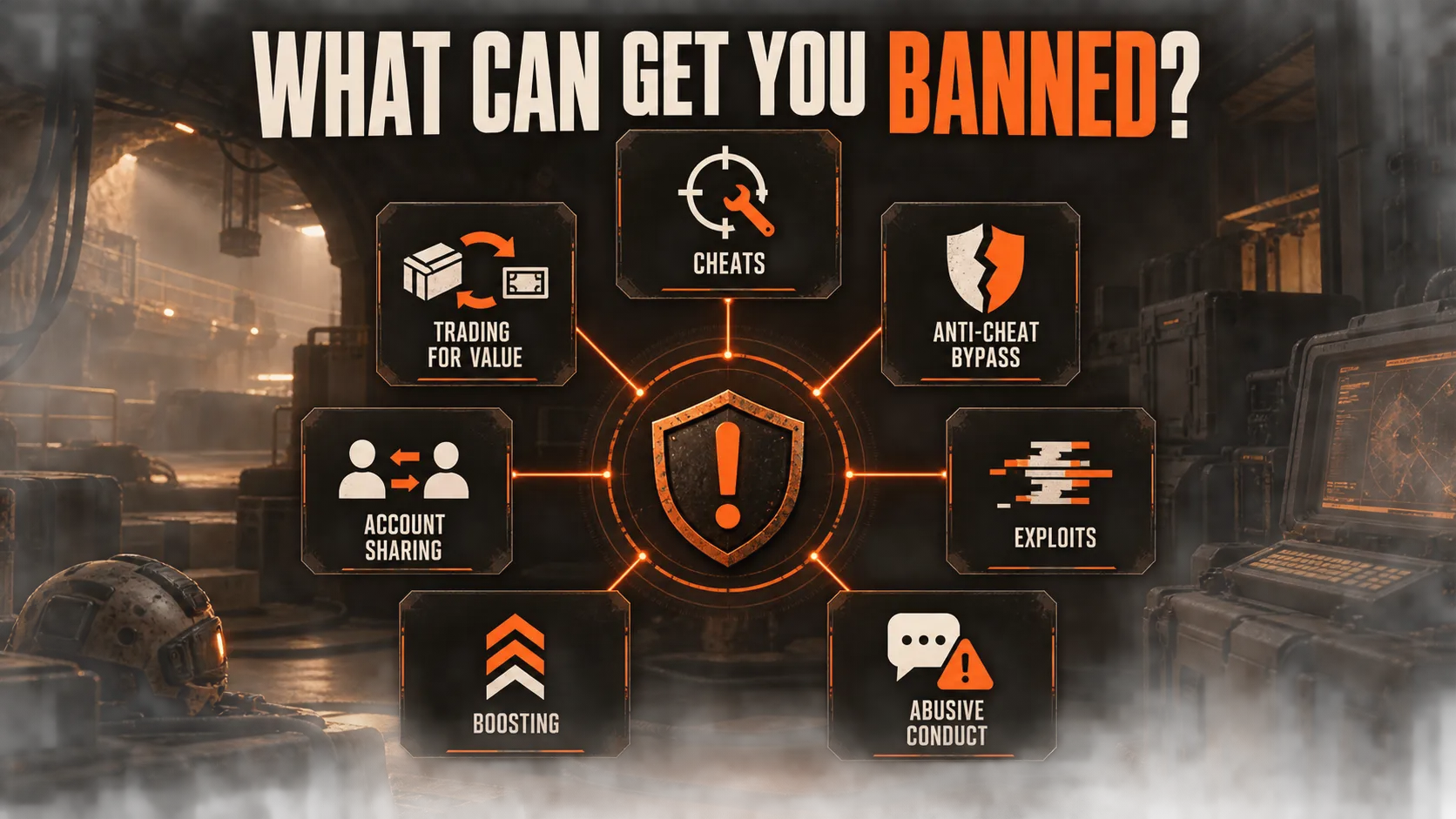
1. Cheats, Hacks or Gameplay-Affecting Third-Party Tools
Software that changes gameplay or creates an unfair advantage can trigger enforcement. That includes obvious cases such as aimbots and wallhacks, but Embark deliberately avoids publishing a complete detection list.
Its anti-cheat guidance also says overlays and assistants are allowed only when they do not interfere with gameplay or provide an unfair advantage.
If a tool falls into a gray area, Embark’s recommendation is to ask Support or stop using it.
For more detail on the security stack behind these decisions, read our ARC Raiders anti-cheat guide.
2. Attempts to Bypass Anti-Cheat Protection
Trying to disable, evade or interfere with anti-cheat protections is a separate policy violation.
It can be enforced even when the bypass attempt is the issue under review rather than a specific in-match action.
3. Exploiting Bugs or Glitches for an Unfair Advantage
Finding a bug and repeatedly using it for an advantage are not treated as the same thing. The policy specifically lists exploitation of bugs or glitches as a reason for a ban.
That can cover actions such as bypassing intended access, duplicating value or repeating a broken interaction after it is clear that the behavior is unintended.
The policy does not promise a warning before enforcement.
4. Abusive Behavior, Hate Speech, Harassment or Stream Sniping
ARC Raiders bans are not limited to cheat detection. Abusive conduct, hate speech, harassment and stream sniping are all named in the policy.
This matters because a player can receive an account action without any prohibited software being involved.
The reason shown in the enforcement notice or provided during an appeal should be treated as the starting point, not assumptions about the anti-cheat.
5. Account Boosting or Farming
Boosting and farming can produce an ARC Raiders ban when they violate Embark’s rules.
The policy does not define a universal numerical threshold, so there is no official number of runs, items or account interactions that makes the behavior acceptable.
Ordinary progression is not the same as organized account manipulation. Risk begins when play is arranged to create illegitimate progress, rewards or rank outcomes.
6. Sharing or Selling an Account
Sharing or selling an ARC Raiders account is listed as a bannable violation. Embark also states that the account owner remains responsible for activity on the account.
If another person uses your account to cheat, the ban will not automatically be removed.
Protecting the login and controlling who can access it are therefore part of avoiding enforcement.
7. Trading Accounts or In-Game Items for Value
Selling an account or exchanging in-game items for money or anything else of value violates the policy.
Dropping an item for another player may be possible inside the game, but attaching an outside payment or exchange changes the situation.
This category covers more than cash sales. Embark’s wording includes trades for anything of value.
Temporary vs Permanent ARC Raiders Bans
The difference is duration, not a separate list of offenses.
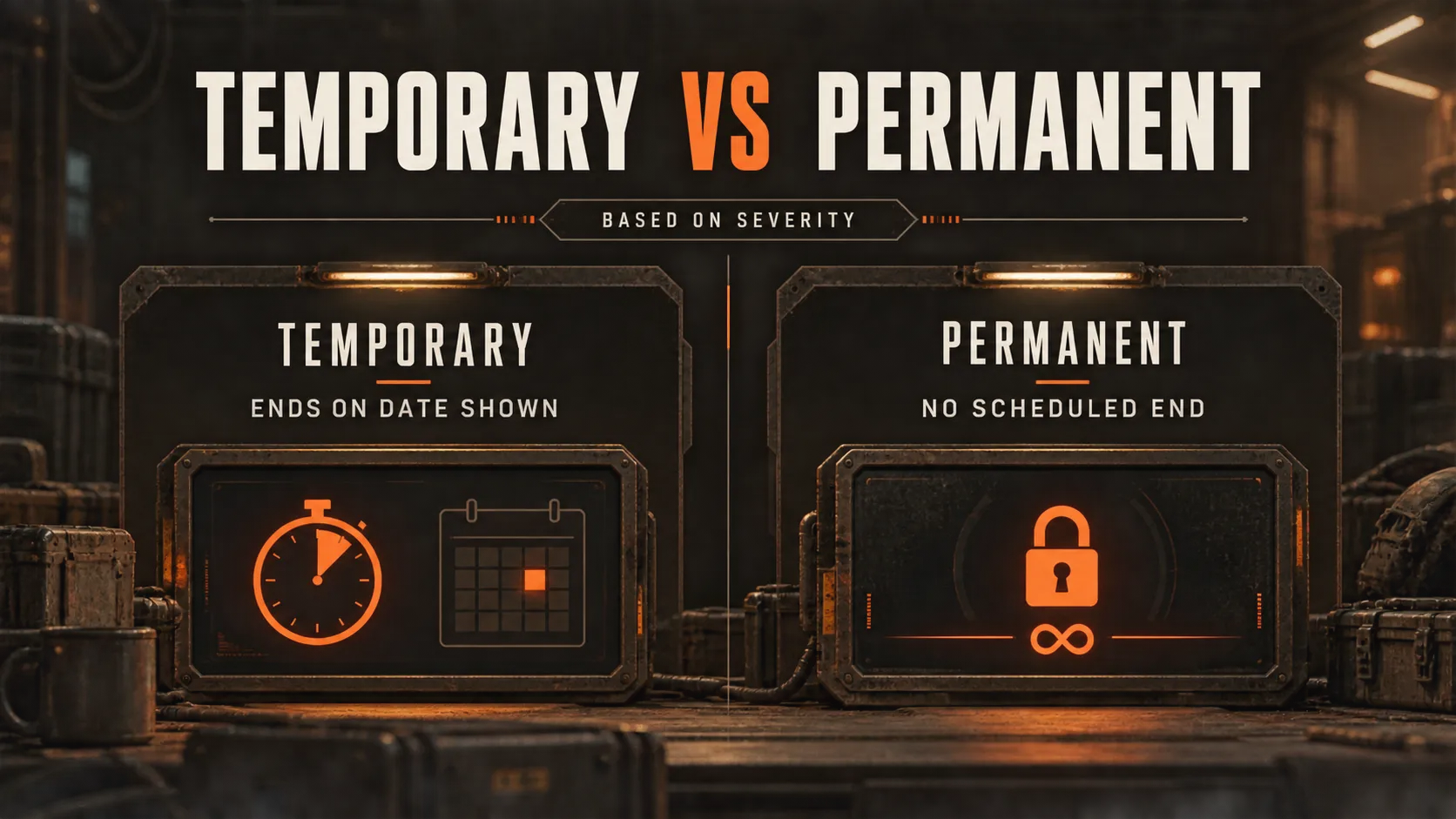
A temporary ban expires on the date shown in the notification, while a permanent ban has no scheduled end.
Embark says severity determines which action applies, but it does not publish a complete offense-to-duration schedule.
That means players should not assume a first offense always produces a temporary ban or that every cheat-related case receives the same penalty.
The notification is the authoritative place to check the type and duration of an account action.
Support may disclose the enforcement reason during an appeal, but it will not provide the detection method or detailed evidence because that information could expose the security system.
Account Ban vs Hardware Ban
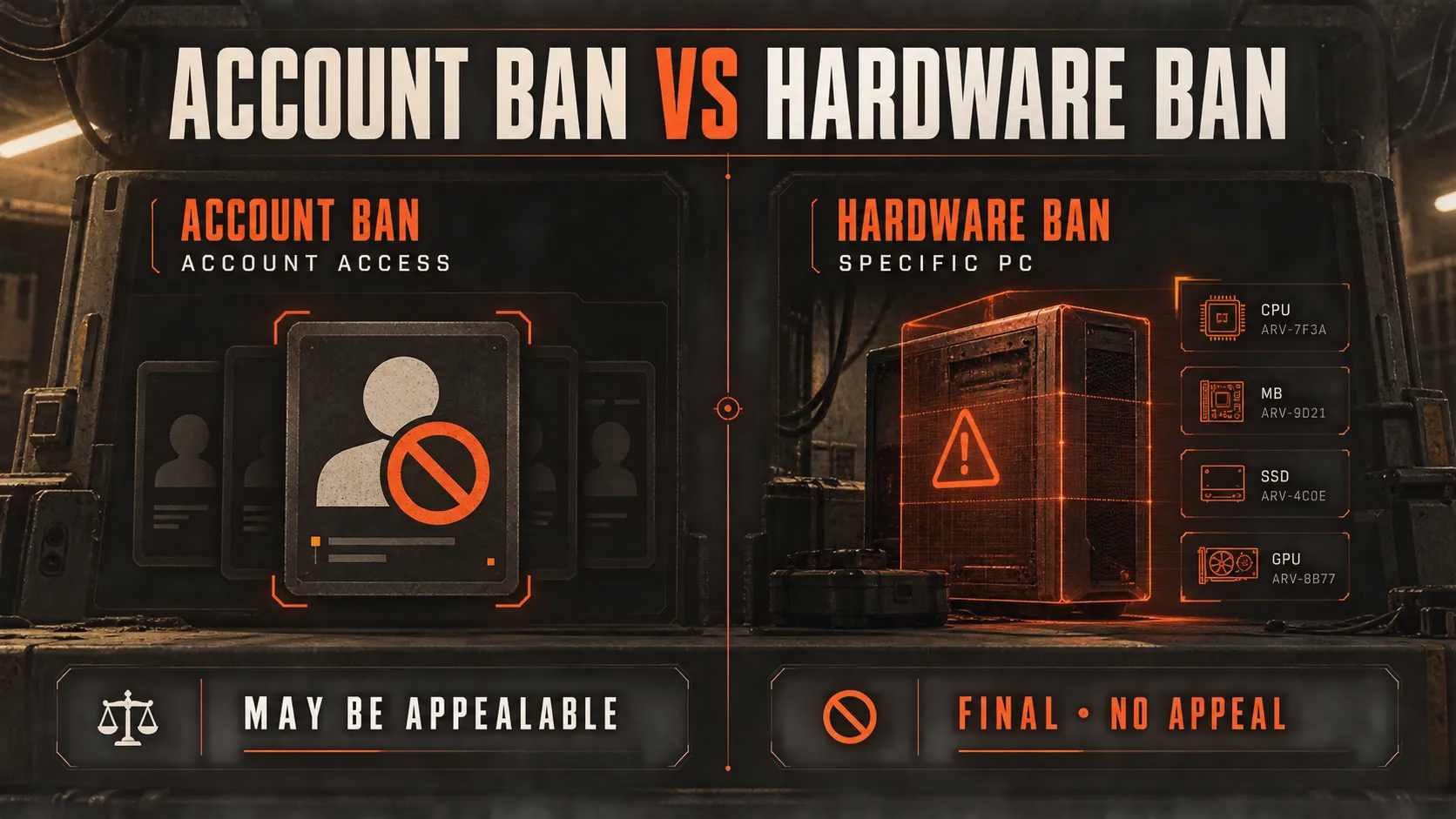
An account ban restricts access associated with an account.
A hardware ban blocks a specific PC from accessing Embark products. Embark says the hardware action itself does not replace or depend on the status of a single account.
According to Embark’s hardware banning guide, hardware bans:
- Are reserved for sufficiently serious violations
- Apply across all Embark titles
- Are final
- Cannot be appealed
Error codes for a restricted machine use the ARAV prefix and end in 17, including ARAV0017, ARAV1017 and other listed variants.
We cover the machine-level restriction, codes and practical distinction in more depth in our ARC Raiders HWID ban guide.
Keeping that topic separate prevents a broad ban-policy article from implying that every banned account is also hardware banned.
Does an Anti-Cheat Error Mean You Are Banned?
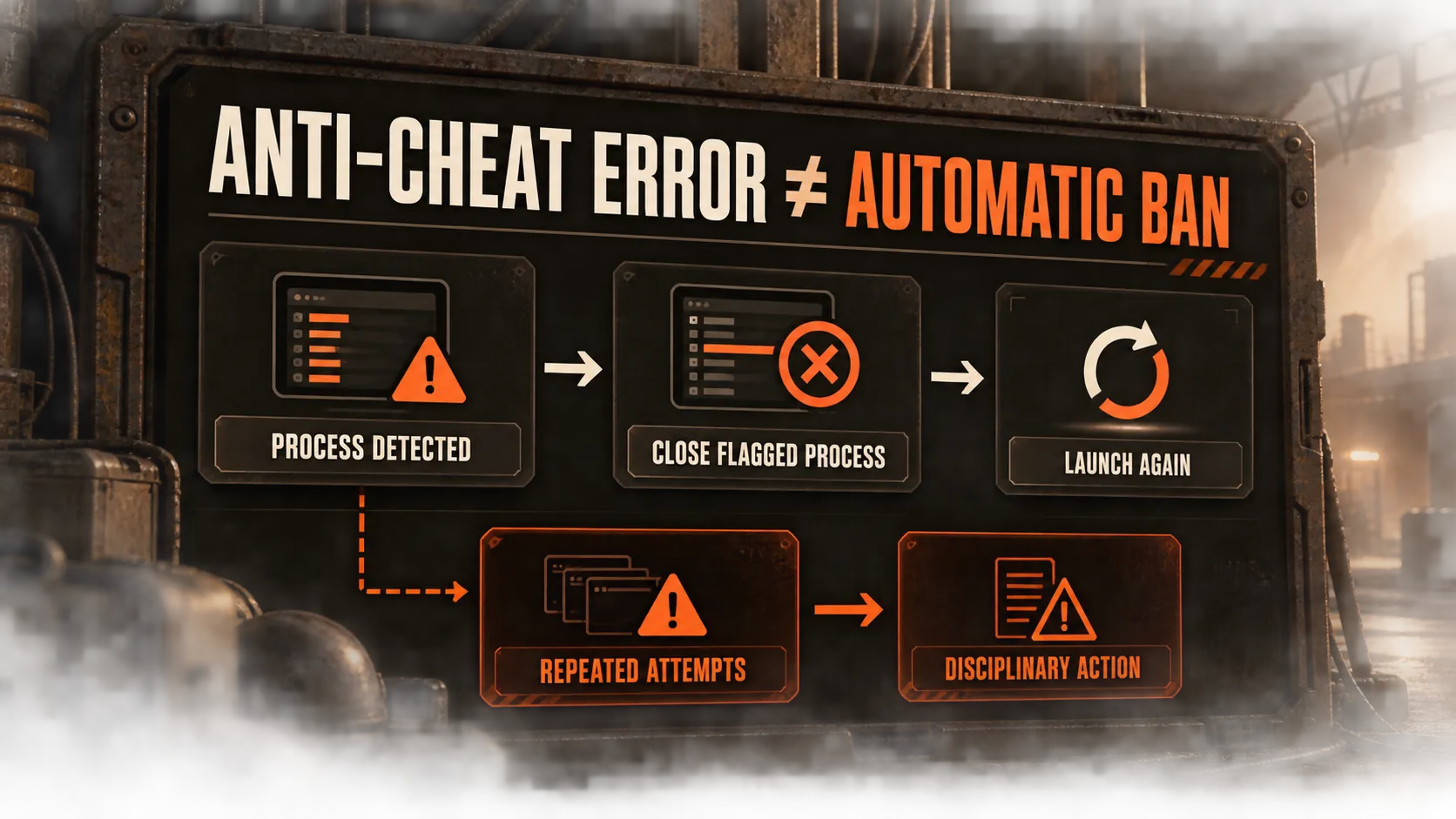
No. An anti-cheat warning or system-integrity error can block the game without being an ARC Raiders ban.
Embark’s support article for the “Cheat Software Detected” fatal error says the message means an active program or process is on its disallowed list.
It explicitly says the error alone is not a ban. The player should close the flagged process before trying again because repeated launch attempts while it remains active can lead to disciplinary action.
The same principle applies to many integrity codes.
A message may point to:
- A prohibited virtual machine
- AutoHotkey
- An auto clicker
- Active scripting
- Cheat Engine
- Disabled security settings
- Another interfering process
Read the exact message and code before concluding that the account has been suspended.
Can Mass Reporting Get You Banned?
Not by itself.
Embark says player reports are reviewed and verified before enforcement, so the number of reports alone does not automatically produce a ban.
Reports can still initiate a review. If that review finds a policy violation, action can follow based on the underlying conduct.
This is different from being banned simply because a group repeatedly selected the report button.
How Steam Family Sharing and Xbox Game Sharing Affect Bans
Shared licenses create a wider enforcement surface, but Steam and Xbox are handled differently.
Embark updated its shared-license restrictions in May 2026.
| Platform | What happens after a ban on a shared license? | What other players need to do |
|---|---|---|
| Steam Family Sharing | Accounts using the shared ARC Raiders license are linked for enforcement; a ban can restrict the entire family group tied to that license | Affected players may need to leave the Steam Family and buy their own copy |
| Xbox Game Sharing | The banned player’s Embark ID is restricted, and the shared license becomes unusable by others on Xbox and Xbox PC | Other family members keep their Embark IDs and can play on another platform if they own the game there |
Shared-license restrictions last for the duration of the underlying ban.
Access returns when the ban expires or is lifted, unless a separate restriction remains.
How to Appeal an ARC Raiders Ban
Eligible account restrictions can be appealed once while they are active. Hardware bans cannot be appealed.
To submit an appeal:
- Open ARC Raiders Support and sign in with the affected Embark ID.
- Select the chat bubble in the lower-right corner.
- Choose Ban Appeals, then Game Ban.
- Include the error or enforcement message and relevant context.
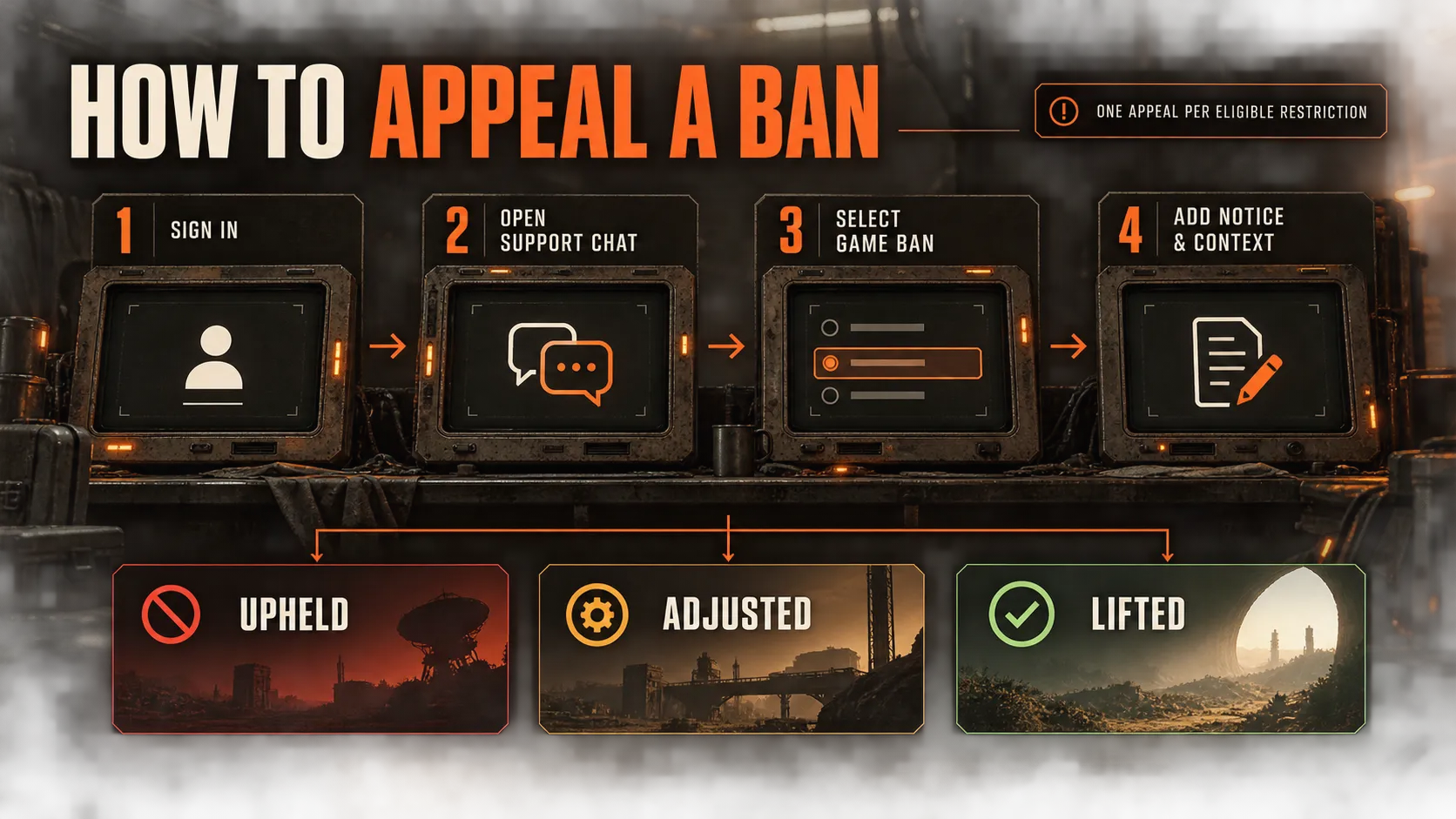
Embark’s ban appeal process has three possible outcomes:
- Upheld: The restriction remains because the reviewer found it was applied correctly.
- Adjusted: The action changes because another penalty better matches the severity.
- Lifted: The restriction is removed because it was applied in error.
Each eligible restriction gets one appeal, so the first submission should be complete.
Include the exact message, date, platform, recent software or hardware changes and any account-security event that could help a reviewer understand the case. Do not send guesses as facts.
What an Appeal Cannot Do
An appeal does not guarantee access will be restored.
It also does not entitle the account owner to the anti-cheat method, detailed evidence or internal detection data.
Embark will not accept an appeal from another person except in rare cases with clear justification.
Banned accounts cannot transfer items or progression to a new account, and in-game purchases are not refundable after a rules-based ban.
Refund eligibility for the base game follows the policy of Steam, Epic Games Store, PlayStation or Xbox.
What the Ban Policy Means for Third-Party Tools
No third-party provider can turn a prohibited tool into an officially approved one or promise zero enforcement risk.
Embark’s rule is based on whether software affects game integrity, provides an unfair advantage or supplies an unauthorized service. Its detection methods also change over time.
Readers comparing our ARC Raiders cheats can review the current feature set and use the free cheat trial to assess setup before purchasing, but neither page overrides Embark’s rules.
The ban policy should be part of that decision, especially if an account, shared license or PC has value you are not prepared to lose.
How to Reduce Accidental Enforcement Problems
These steps do not make prohibited behavior safe.
They help legitimate players distinguish configuration problems from actual account enforcement and give Support cleaner information if something goes wrong.
- Close macro tools, injectors, AutoHotkey scripts, auto clickers and custom overlays before launching.
- Keep Windows security features and the operating system updated.
- Read the full error code instead of treating every blocked launch as a ban.
- Secure the Embark ID and connected platform account with unique credentials and available authentication controls.
- Avoid account sharing, paid item transfers and boosting services.
- Stop repeated launch attempts after the anti-cheat names a disallowed active process.
- Save the enforcement notice and submit one complete appeal if the action appears incorrect.
Key Takeaways
- ARC Raiders uses temporary and permanent account bans based on severity.
- Seven named policy categories include cheats, bypass attempts, exploits, abusive conduct, boosting, account sharing and trading for value.
- Serious enforcement can extend across Embark titles.
- A hardware ban blocks a specific PC across Embark products and cannot be appealed.
- Steam and Xbox shared licenses can affect access for players who were not using the banned Embark ID.
- A fatal anti-cheat or integrity error is not automatically a ban.
- Eligible active account restrictions receive one appeal with upheld, adjusted or lifted outcomes.
Frequently Asked Questions
Is an ARC Raiders ban temporary or permanent?
It can be either.
Embark selects a temporary or permanent account restriction based on the severity of the offense, and the notification shows the action applied to the account. There is no public penalty table guaranteeing a temporary first offense.
Can you get permanently banned for cheating in ARC Raiders?
Yes.
Cheats, hacks, gameplay-affecting third-party tools and attempts to bypass anti-cheat protections are all bannable. Embark uses permanent penalties for cases it considers severe, but it does not publish every detection rule or threshold.
Does ARC Raiders issue hardware bans?
Yes.
Embark can issue a hardware ban for a sufficiently serious offense. It blocks the specific PC from accessing Embark products, applies across Embark games and is final.
Can you appeal an ARC Raiders hardware ban?
No.
Embark states that hardware bans are final and non-appealable. The standard appeal route applies only to eligible active account restrictions.
How many times can you appeal an ARC Raiders ban?
You can submit one appeal per eligible restriction while it is active.
A reviewer may uphold, adjust or lift the action. Include all relevant context in the first submission because repeated appeals are not part of the published process.
Can mass reports get an ARC Raiders account banned?
Not on report volume alone.
Embark says reports are reviewed and verified before action is taken. A report can lead to an investigation, but enforcement should depend on the conduct found during that review.
Is “Cheat Software Detected” already a ban?
No.
Embark says that fatal error means a disallowed program or process is active, not that the account is already banned. Close the named process before launching again because repeated attempts can lead to disciplinary action.
Can AutoHotkey get you banned in ARC Raiders?
An active AutoHotkey script can trigger anti-cheat or system-integrity detection.
Embark advises disabling the process, and repeated attempts to launch with flagged software can escalate into account action. The exact message and code determine whether you are seeing a warning, blocked launch or restriction.
Can a family member’s ban affect my ARC Raiders access?
Yes, when a shared game license is involved.
Steam accounts in the same shared-license family can receive restrictions, while an Xbox ban can make the shared license unusable even though other family members keep their own Embark IDs.
The platform-specific rules differ, so check the shared-license notice rather than assuming the account itself was banned.
Can a banned ARC Raiders account transfer its items or progress?
No.
Embark says banned accounts are not eligible for item or progression transfers. Creating another account does not create a right to move the old account’s inventory or progress.
Can ARC Raiders ban you across other Embark games?
Yes.
Embark says serious account violations can result in a ban across its published titles. Hardware bans already apply to all Embark games from the restricted PC.