ARC Raiders cheat terminology gets confusing fast.
A provider may list ESP, Wallhack, Radar, weapon mods and a spoofer without explaining where one feature ends and another begins.
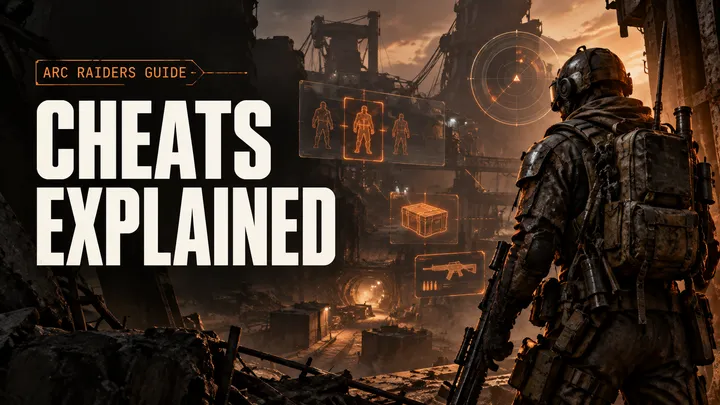
This ARC Raiders cheats explained guide separates the main categories, shows how they change an extraction run, and clarifies what detection status and ban risk mean.
It is a terminology guide, not a product ranking or a promise that any cheat is permanently safe.
Table of Contents
- What Are ARC Raiders Cheats?
- ARC Raiders Cheat Types at a Glance
- How Do ARC Raiders Cheats Work?
- Aimbot
- ESP and Wallhack
- Loot ESP
- Radar
- Weapon Modifications
- HWID Spoofer
- Stream-Safe Mode
- Undetected Status
- Anti-Cheat and Bans
- [How to Compare Cheat Feature Lists]> (#how-to-compare-arc-raiders-cheat-feature-lists)
- Key Takeaways
- FAQ
What Are ARC Raiders Cheats?
ARC Raiders cheats are third-party tools that expose information, adjust aim or weapon behavior, or add protection features that are not part of the standard game.
The broad label covers several different systems, rather than one universal feature.
That distinction matters in an extraction shooter.
An Aimbot affects target acquisition. Player ESP exposes threats that should be hidden by distance or cover. Loot ESP filters items and containers. Radar compresses selected positions into a map-style view.
Weapon modifications change gun behavior, while an HWID Spoofer is a protection feature rather than an in-raid combat tool.
“Cheats” and “hacks” are normally used as search synonyms in this context.
Neither word tells you which modules a particular build contains, how they are presented, or what its current detection status is. The feature list does.
ARC Raiders Cheat Types at a Glance
| Cheat type | Main job | Typical information or control | What it is not |
|---|---|---|---|
| Aimbot | Aim assistance | Target filters, aim point, FOV, smoothing, prediction | A visibility overlay |
| Player ESP / Wallhack | Threat awareness | Players, ARC machines, boxes, skeletons, health, distance, through-wall visibility | Loot filtering |
| Loot ESP | Item and route awareness | Items, rarity, value, containers, corpses, drops, extraction zones | A combat targeting tool |
| Radar | Spatial overview | Direction and relative position of selected entities and markers | The same visual format as ESP |
| Weapon modifications | Gun-behavior control | Recoil, spread, sway and crosshair options | An aim-selection system |
| HWID Spoofer | Hardware-identity protection | Masks or changes identifiers exposed to software | A guarantee against account or hardware bans |
| Stream-Safe Mode | Capture-output control | Attempts to keep supported overlays out of recorded or streamed output | Protection from anti-cheat detection |
ARC Raiders Ultimate combines these categories in one complete build, rather than selling Aimbot, ESP, Radar or weapon modifications separately.
The current feature set includes Aimbot, Player and Loot ESP, Wallhack, Radar, weapon mods, HWID Spoofer and Stream-Safe Mode.
You can review the complete ARC Raiders Ultimate cheat for the full feature list, or continue below to understand what each category does and how the terminology differs.
The categories can exist in the same build, but they solve different problems.
A complete list should tell you which entities each module supports, how the information is filtered and whether every option is currently available on the platform you plan to use.
How Do ARC Raiders Cheats Work?
At a high level, most cheat features perform one or more of four jobs:
- Read or infer game state. A tool identifies supported entities or values, such as player positions, target movement, item categories or weapon behavior.
- Filter the result. Settings decide which players, machines, items or distances are relevant. This keeps the output from becoming unusable.
- Present or act on the result. ESP draws information, Radar converts it into a map-style view, and an Aimbot uses eligible targets to influence aim correction.
- Control activation and output. Keybinds, hold/toggle modes, distance limits, display options and stream-output settings determine when and where a module appears.
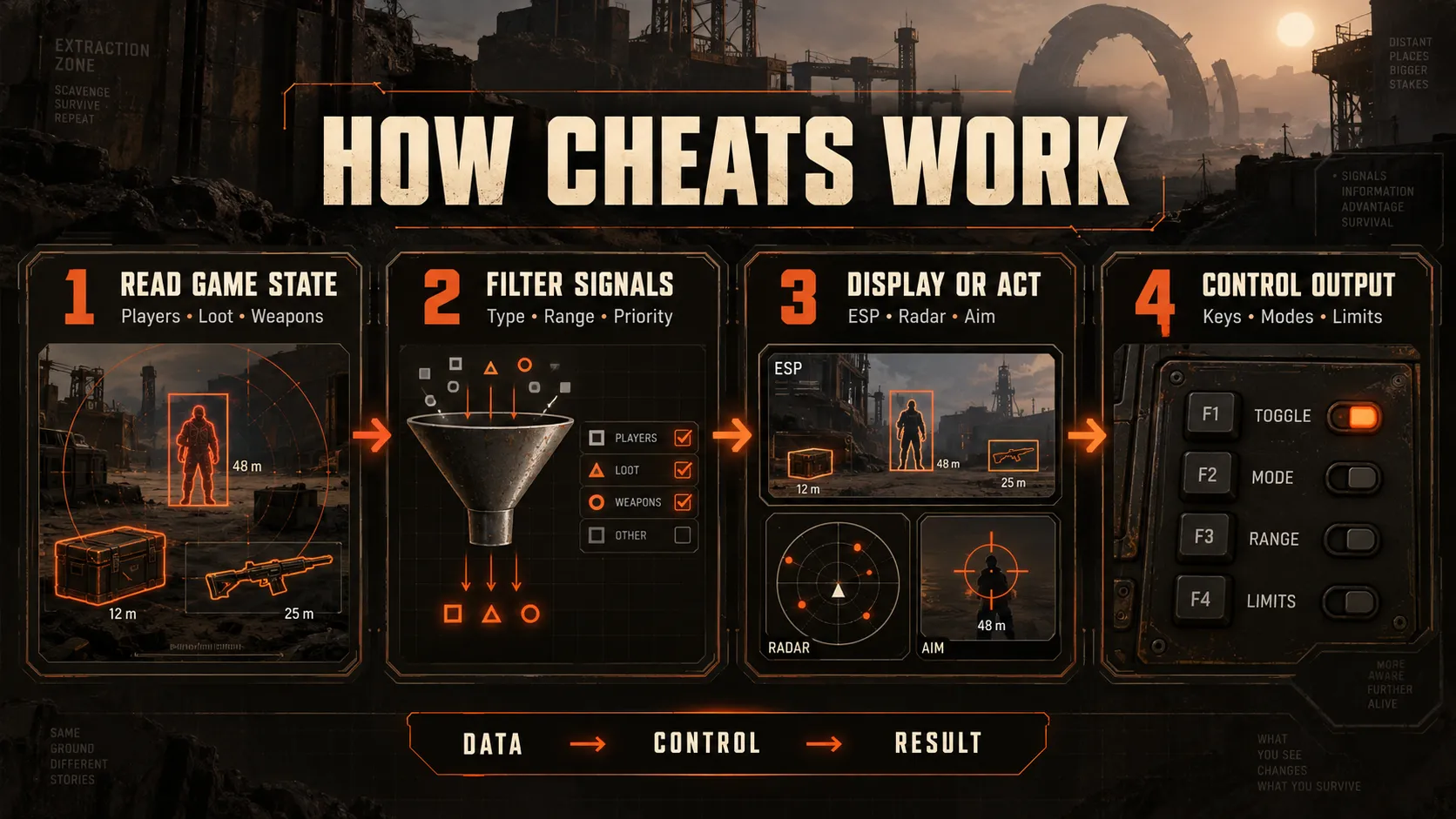
The exact implementation is not public and can vary between builds.
Marketing terms also vary, so two providers can use the same label for different controls.
The safest way to read a feature list is to ask three questions: What data does the module use? What does the user control? What appears or changes during a raid?
ARC Raiders Aimbot Explained
An Aimbot helps select and track an eligible target. It is not simply “automatic headshots.”
The actual behavior depends on the target filters, aim point and correction settings included in the build.
Common controls include:
- Target type: enemy Raiders, ARC machines or both
- Target priority: closest to the crosshair, closest by distance or lowest health
- Aim point: automatic bone selection or a chosen body point
- FOV: the area inside which a target can become eligible
- Smoothing and speed: how the correction moves toward the aim point
- Prediction: adjustment for target movement
- Visibility and distance checks: rules that exclude hidden or distant targets
- Target lock and switching: how long a selected target stays active and when the system moves on
Rage, Legit and Silent Aim describe different behavior profiles, not separate universal technologies.
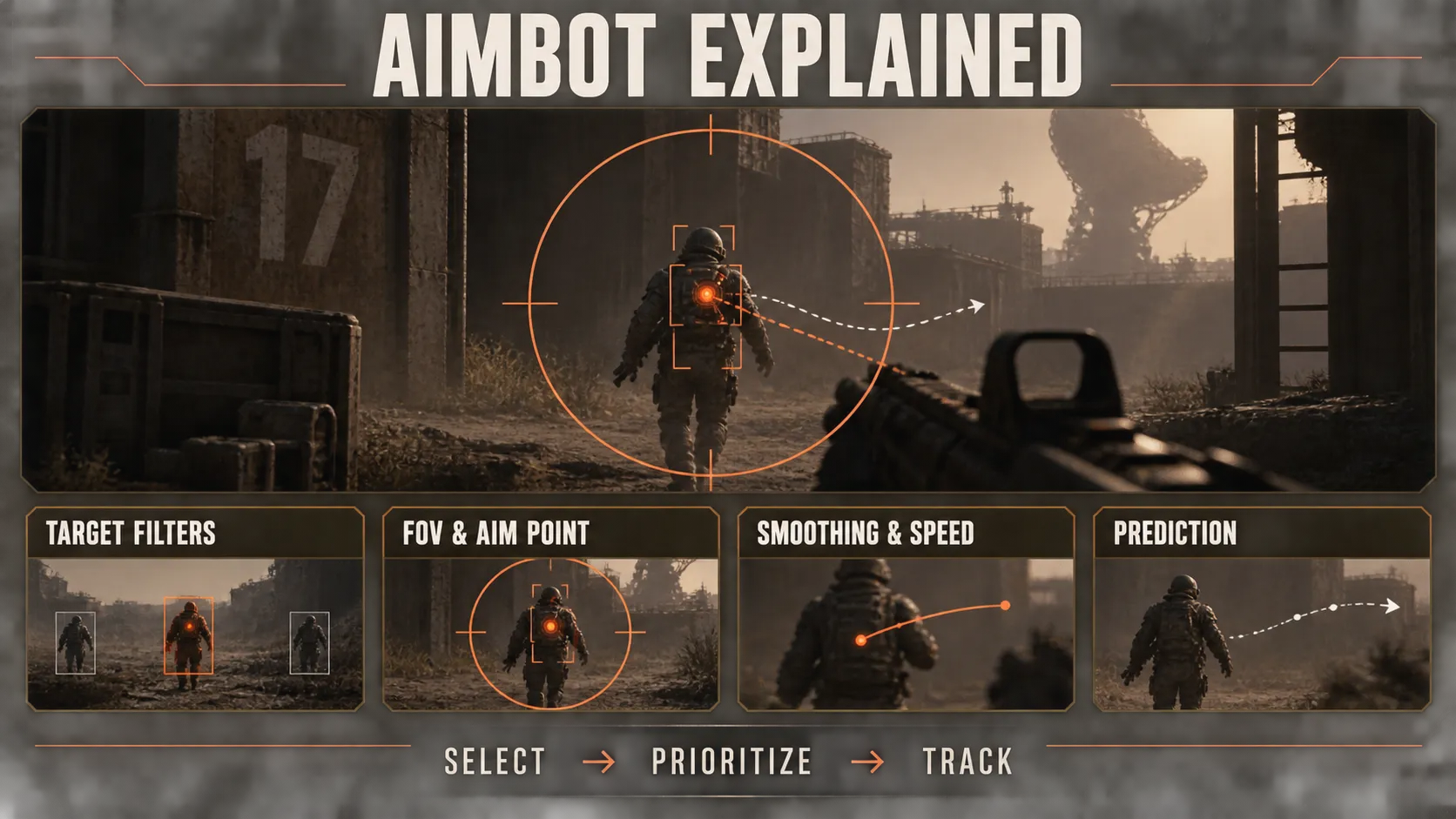
Providers may define those labels differently.
Our dedicated ARC Raiders Aimbot page documents the exact controls in the current ARC Raiders Ultimate build without turning this pillar article into a second Aimbot landing page.
ARC Raiders ESP and Wallhack Explained
ESP stands for extra-sensory perception.
In cheat terminology, ESP is an overlay that displays information the normal interface does not provide.
A Wallhack is usually the through-cover part of that visual system.
Player ESP can display boxes, skeletons, names, health, armor, distance, equipment, view direction or other supported attributes.
ARC Machine ESP applies the same concept to machines.
Filters and maximum-distance settings matter because drawing every available element at once can make the screen harder to read.
The terms overlap, but they are not always interchangeable:
- ESP is the broader information layer.
- Wallhack describes visibility through walls, terrain or other cover.
- Chams usually means model coloring or material changes, where supported.
- Snaplines and off-screen arrows are direction aids within an ESP system.
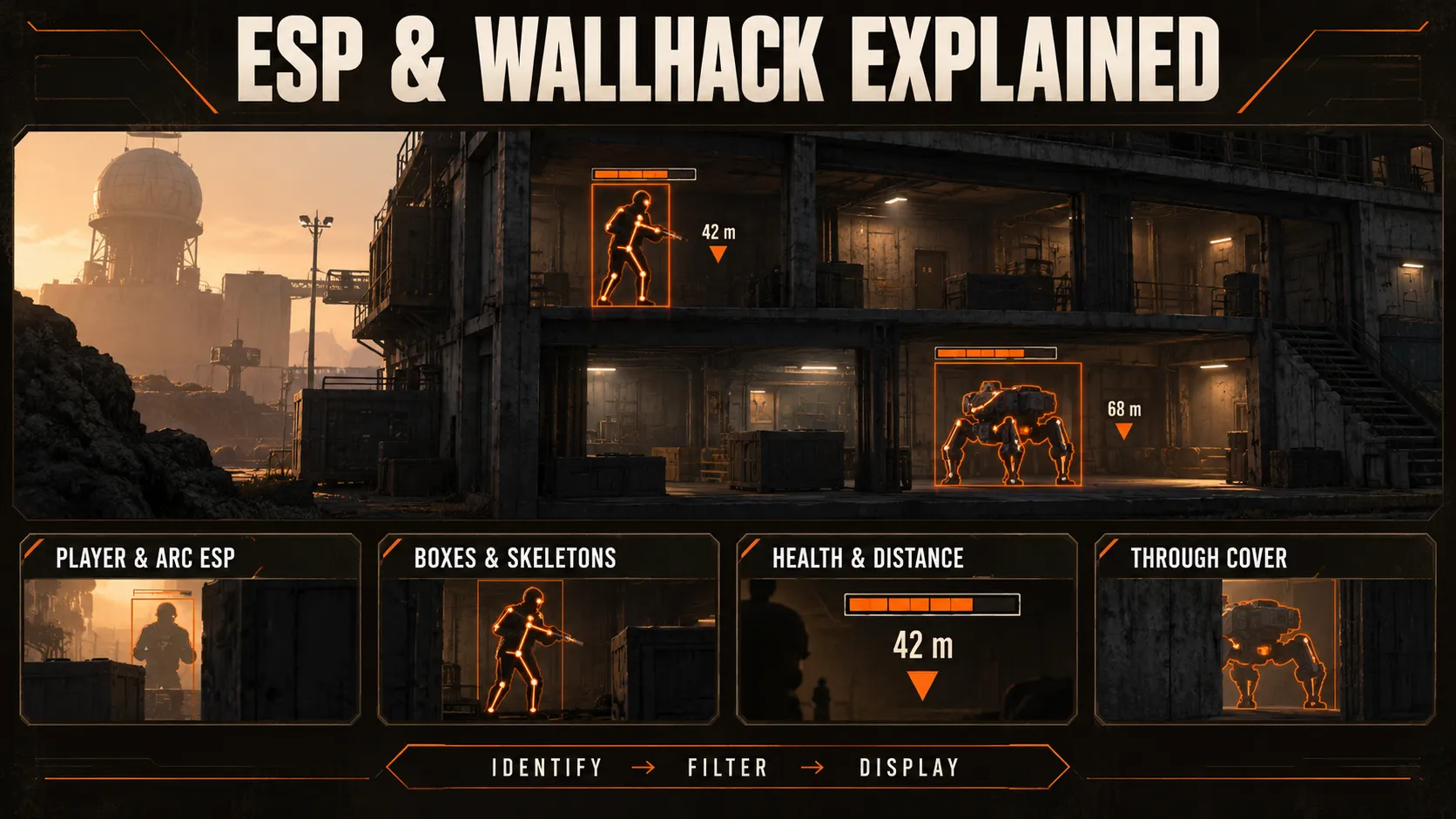
ARC Raiders Ultimate separates the full option list on its ESP and Wallhack page.
Keeping the detailed settings there protects this article from competing with the feature page for the same narrow query.
ARC Raiders Loot ESP Explained
Loot ESP applies information filtering to items and world objects, rather than combat targets.
It can identify supported items, containers, corpses, drops and extraction-related markers before they would be easy to recognize through normal play.
Useful Loot ESP controls usually answer four questions:
- What is it? Item names, container types and category labels
- Is it valuable? Rarity colors, price or value filters
- How far away is it? Distance labels and maximum display ranges
- Does it matter to this run? Category toggles and extraction markers
Loot ESP and Player ESP can share an overlay, but their decisions are different.
Player ESP is about threat awareness. Loot ESP is about search efficiency and route decisions.
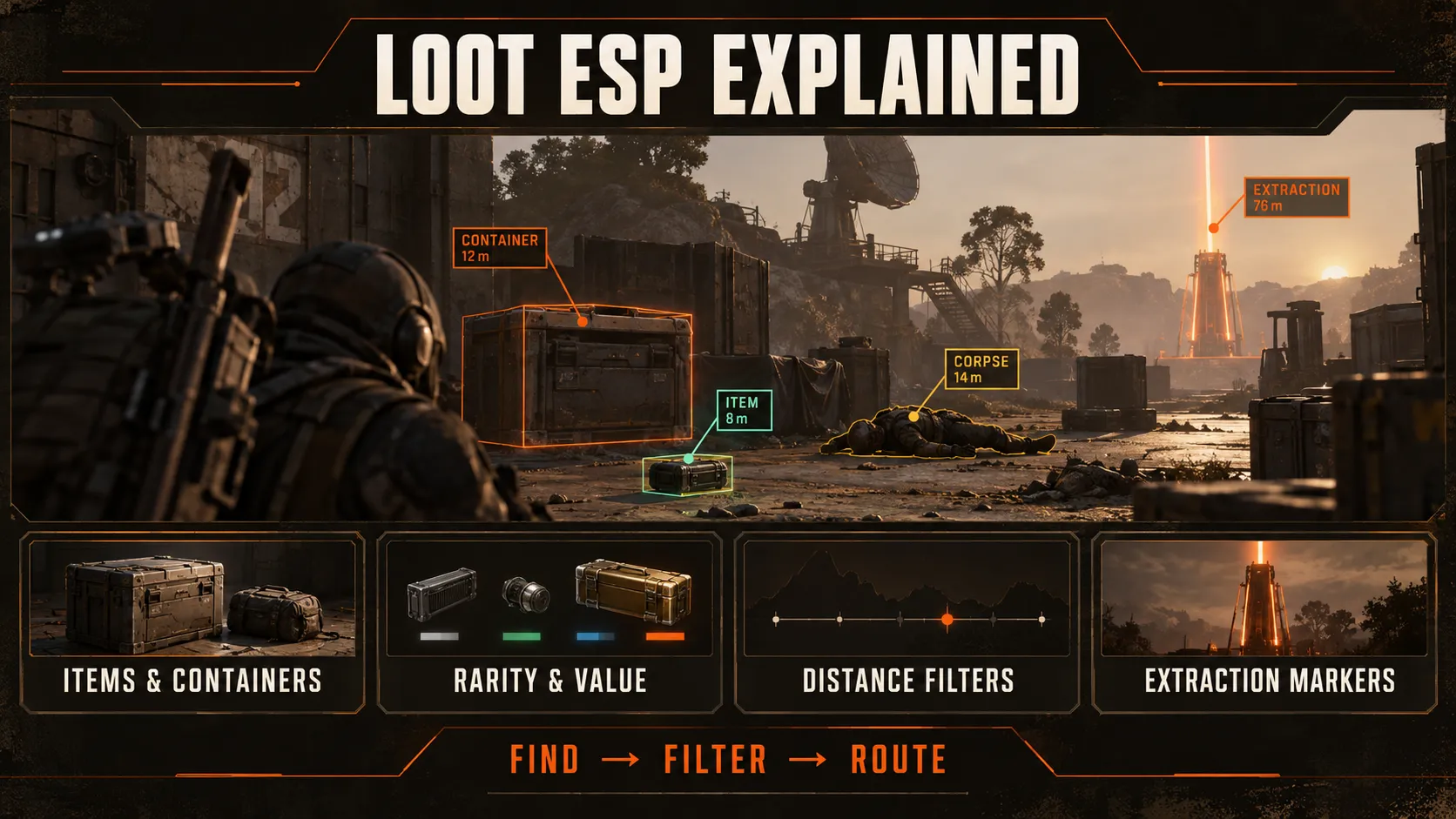
The ARC Raiders Loot ESP page covers the supported categories and filters in more detail.
ARC Raiders Radar Explained
Radar converts selected entity positions into a compact spatial view.
Instead of drawing a box around a target in the 3D scene, it represents direction and relative position on a 2D overlay.
That makes Radar useful for reading the space around a player: where a threat is approaching from, where teammates are positioned, and where supported loot or extraction markers sit relative to the current route.
It can complement ESP, but it does not replace every ESP detail.
A radar blip can show direction quickly, while a full ESP label can show health, distance, equipment or entity type.
The important settings are the supported entity categories, range, scale, rotation and marker style, plus whether the view stays centered on the player.
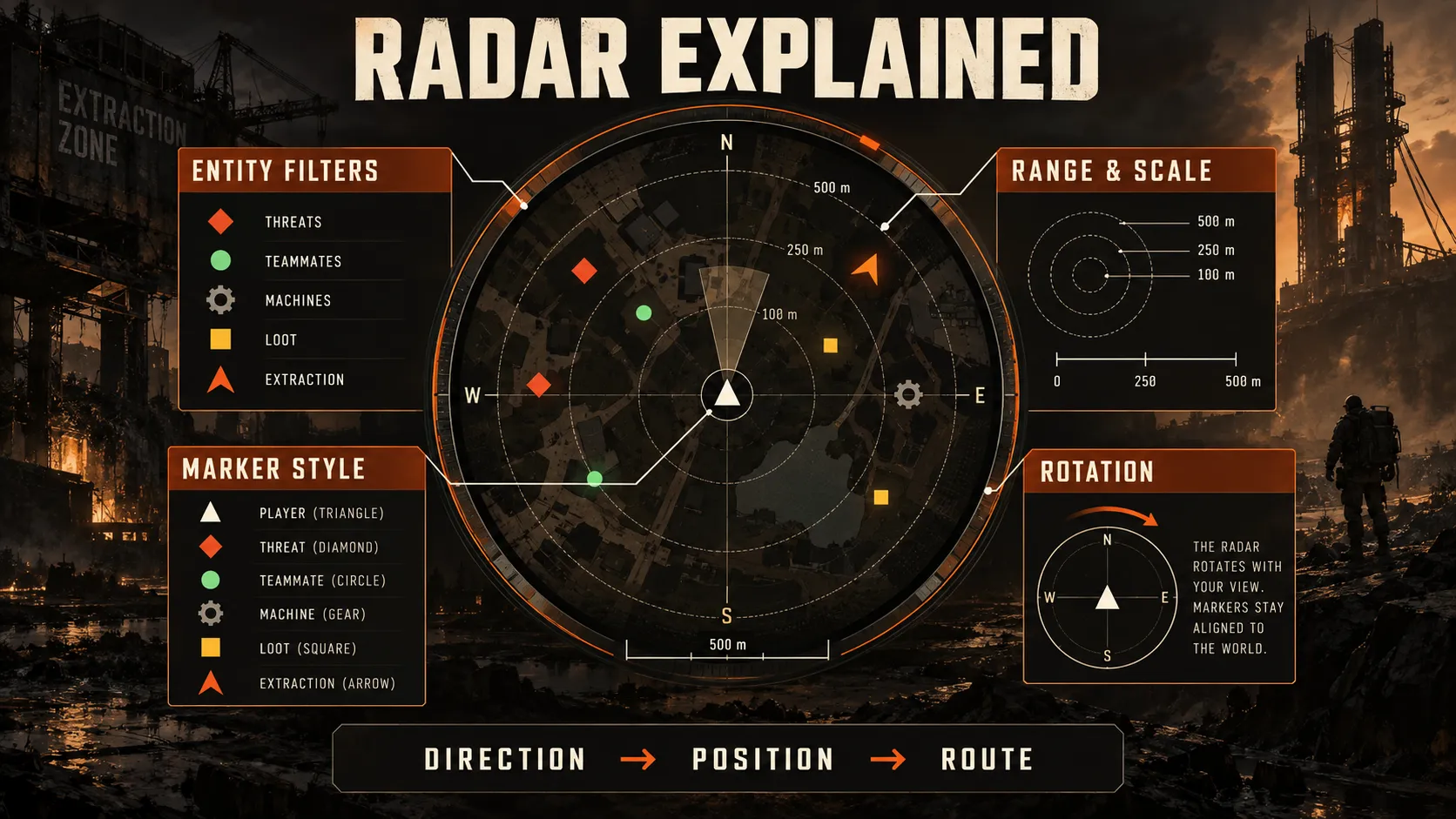
Our ARC Raiders Radar breakdown lists the current implementation separately.
ARC Raiders Weapon Modifications Explained
Weapon modifications change how a gun behaves or how aiming information is presented.
They are distinct from Aimbot because they affect the weapon or reticle rather than choosing a target.
The main terms are:
- No Recoil: reduces or removes vertical and horizontal weapon kick.
- No Spread: reduces shot dispersion around the aim point.
- No Sway: reduces movement in the weapon or sight while aiming.
- Custom Crosshair: adds an adjustable reference point to the screen.
These features are often bundled under “weapon mods,” but each should have its own toggle or strength control if the build supports separate configuration.
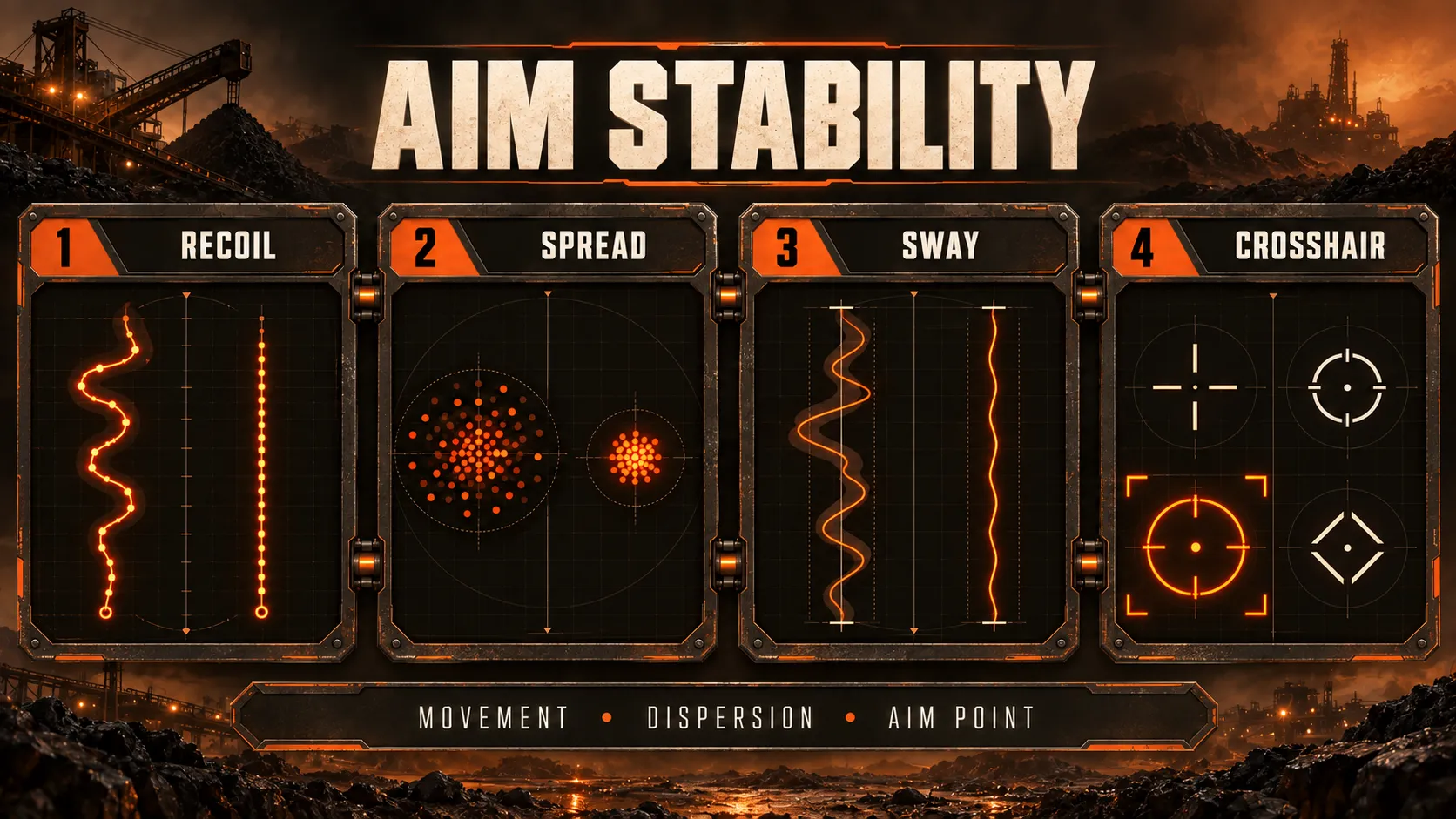
Read the ARC Raiders No Recoil page for the current recoil, spread, sway and crosshair options.
ARC Raiders HWID Spoofer Explained
HWID means hardware ID.
An HWID Spoofer is designed to mask or alter hardware identifiers that software can use to recognize a PC.
It is a protection feature, not a combat feature.
That difference is easy to miss.
Account enforcement targets an account, while hardware enforcement targets a machine.
Embark officially states that hardware bans exist, apply across Embark products and are final.
It does not publish the exact hardware fingerprint used to identify a restricted PC.
A spoofer should not be described as a guaranteed “unban” button.
It does not erase an account penalty, make a detected build safe or promise immunity from future enforcement.
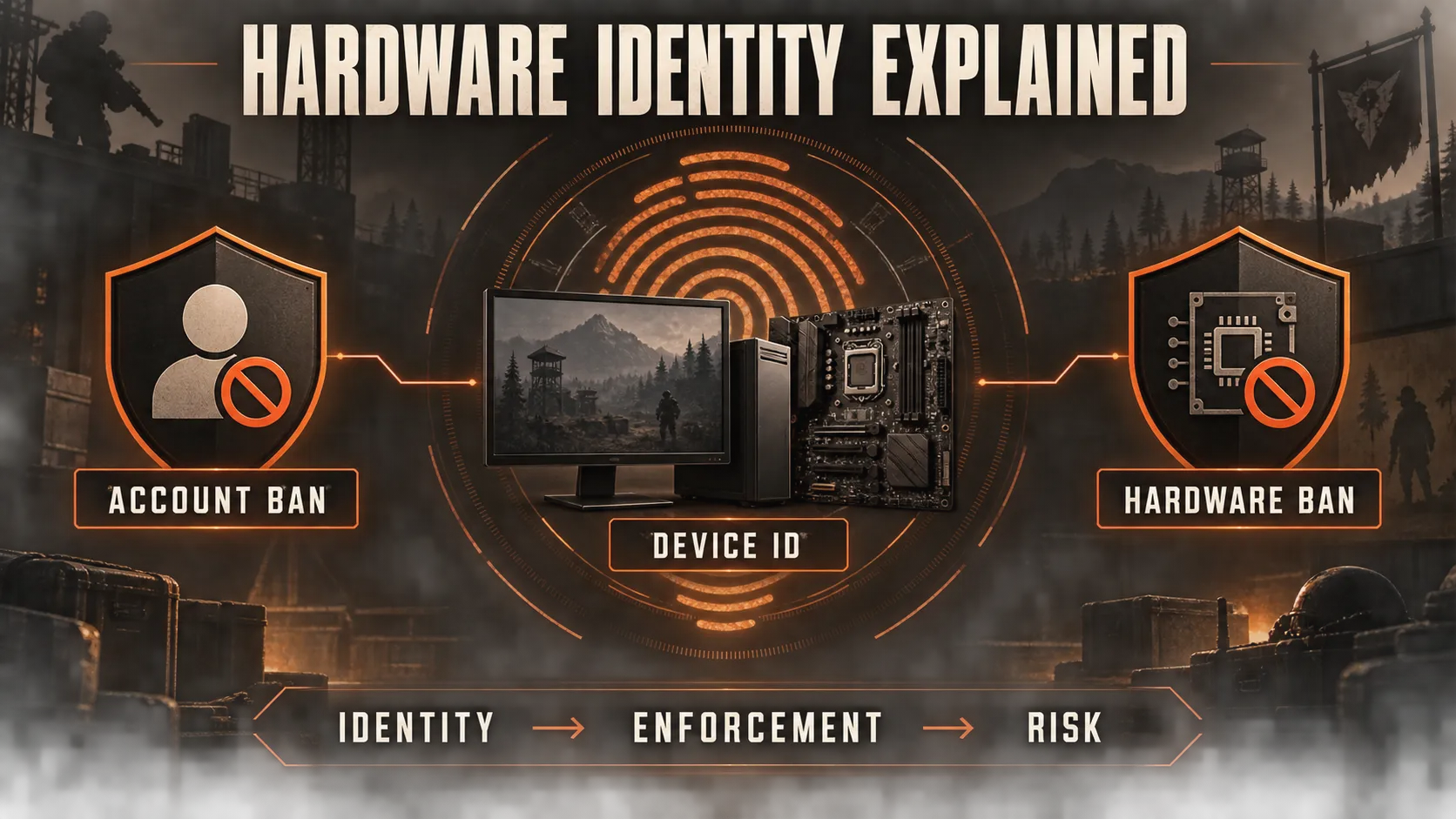
Our ARC Raiders HWID ban guide explains Embark’s published enforcement rules and restricted-machine errors.
What Does Stream-Safe Mode Mean?
Stream-Safe Mode is designed to keep supported cheat visuals out of a recording or broadcast capture.
It can be useful when someone wants the local display and the captured output to show different layers.
It does not mean anti-cheat-safe, undetected or ban-proof.
Capture visibility and anti-cheat detection are separate questions.
A feature can be hidden from a streaming application while still interacting with a protected game environment.
Treat “stream-safe” as an output feature only.
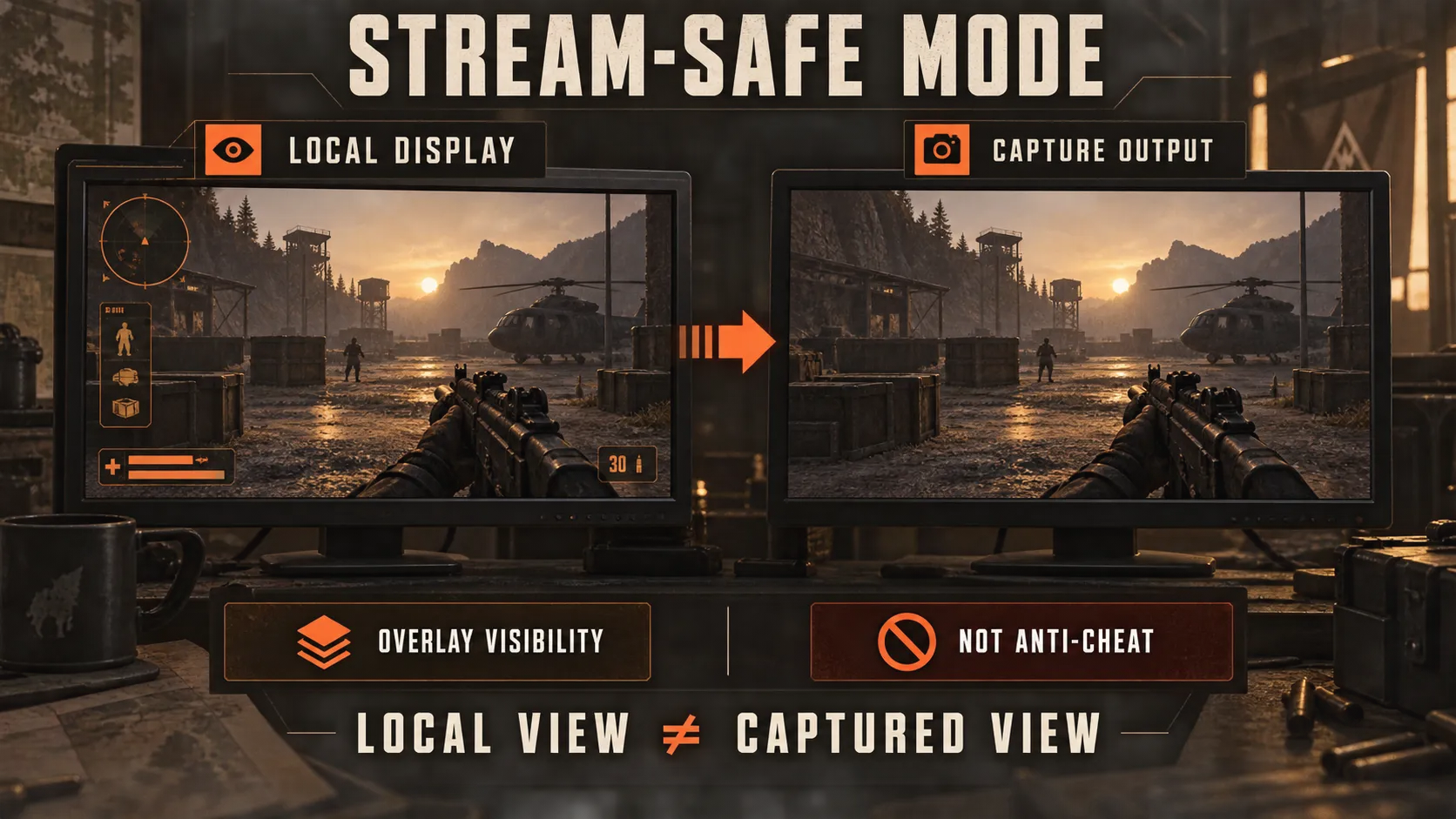
The provider should state which capture methods are supported and whether every overlay module follows the same rule.
What Does “Undetected” Mean for an ARC Raiders Cheat?
“Undetected” is a current-status claim, not a permanent property.
In responsible usage, it means the provider has no known active detection affecting the tested build at the time the status was checked.
It does not mean:
- the cheat cannot be detected later;
- every user, platform and configuration has identical risk;
- reports, telemetry or manual review no longer matter;
- a game or anti-cheat update cannot change compatibility;
- an HWID Spoofer guarantees protection.
Status is time-sensitive because both the game and its security layers change.
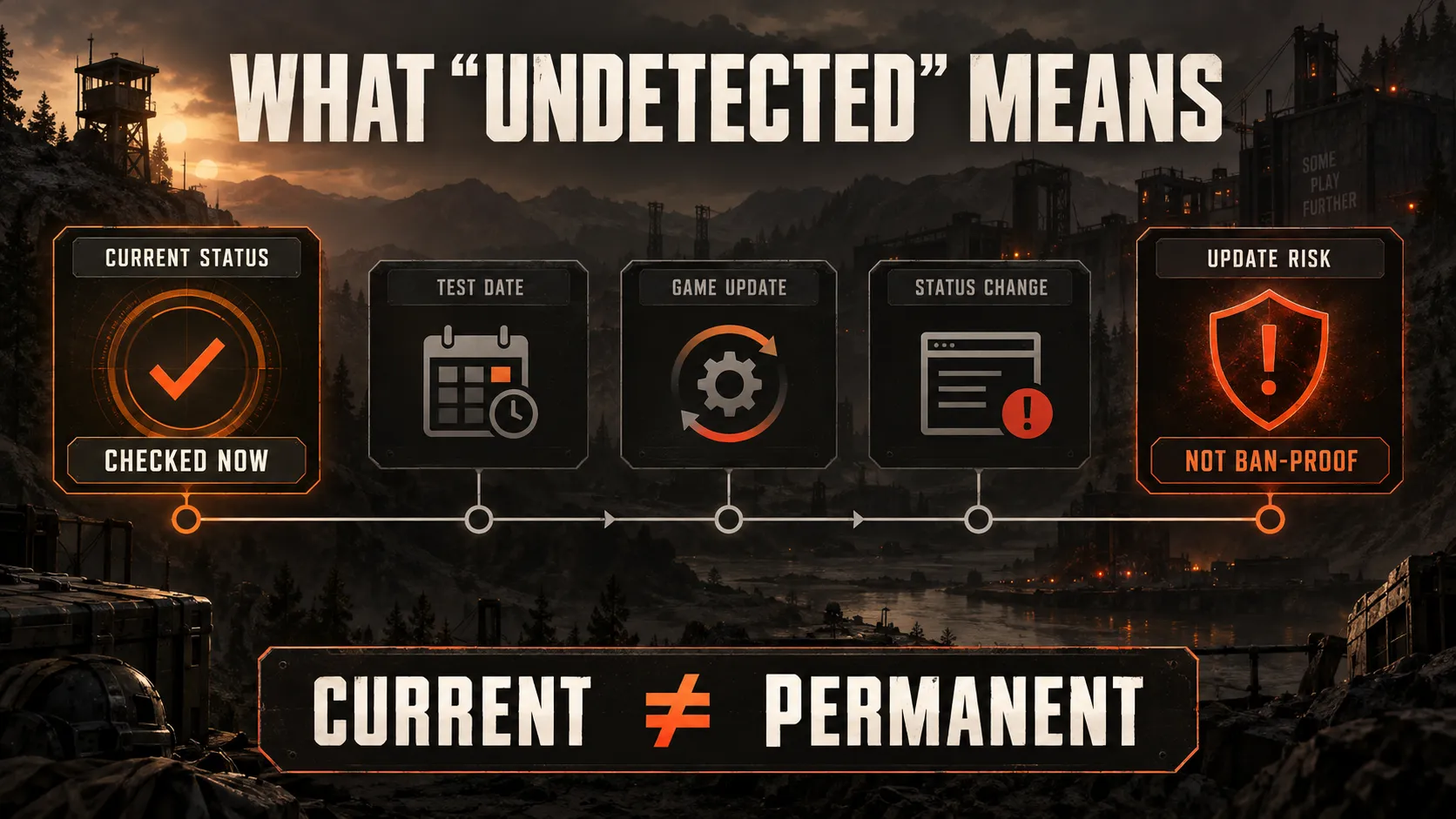
Embark’s September 8 patch notes confirm Update 1.45.0 as the latest Live Update at the time of this review, with another smaller update planned before the October 8 release.
Compatibility should be checked after every update rather than inferred from an older label.
ARC Raiders Anti-Cheat, Detection and Ban Risk
ARC Raiders does not rely on a single security layer.
Embark’s official Ensuring Fair Play update confirms kernel-level Easy Anti-Cheat, machine-learning models trained on player telemetry, input-telemetry analysis developed with Anybrain and additional undisclosed protections.
Embark later completed the Denuvo Anti-Cheat rollout, making “it only uses EAC” an incomplete description of the current stack.
Detection can also refer to different events:
| Term | What it usually means |
|---|---|
| Compatibility issue | A feature or build does not work correctly after a game or system change |
| Anti-cheat error | The game blocks a launch or session because of a process, configuration or integrity condition |
| Cheat detection | A security layer identifies prohibited software or behavior |
| Player report | Another player flags suspicious behavior for review |
| Account ban | The account loses access temporarily or permanently |
| Hardware ban | The PC is restricted under Embark’s hardware-enforcement policy |
Not every integrity error is already a ban, and not every ban is a hardware ban.
Embark’s ban and enforcement policy allows temporary or permanent account action based on severity.
Its separate hardware-banning guidance describes hardware bans as final and non-appealable.
No legitimate status explanation should promise zero risk.
For the full system rather than a short summary, read our ARC Raiders anti-cheat guide.
The ARC Raiders ban policy guide separates warnings, temporary bans, permanent bans, shared-license restrictions and hardware enforcement.
How to Compare ARC Raiders Cheat Feature Lists
A long feature list is not automatically a clear one.
Use this framework to compare what a build actually includes without turning the process into a “best cheats” ranking.
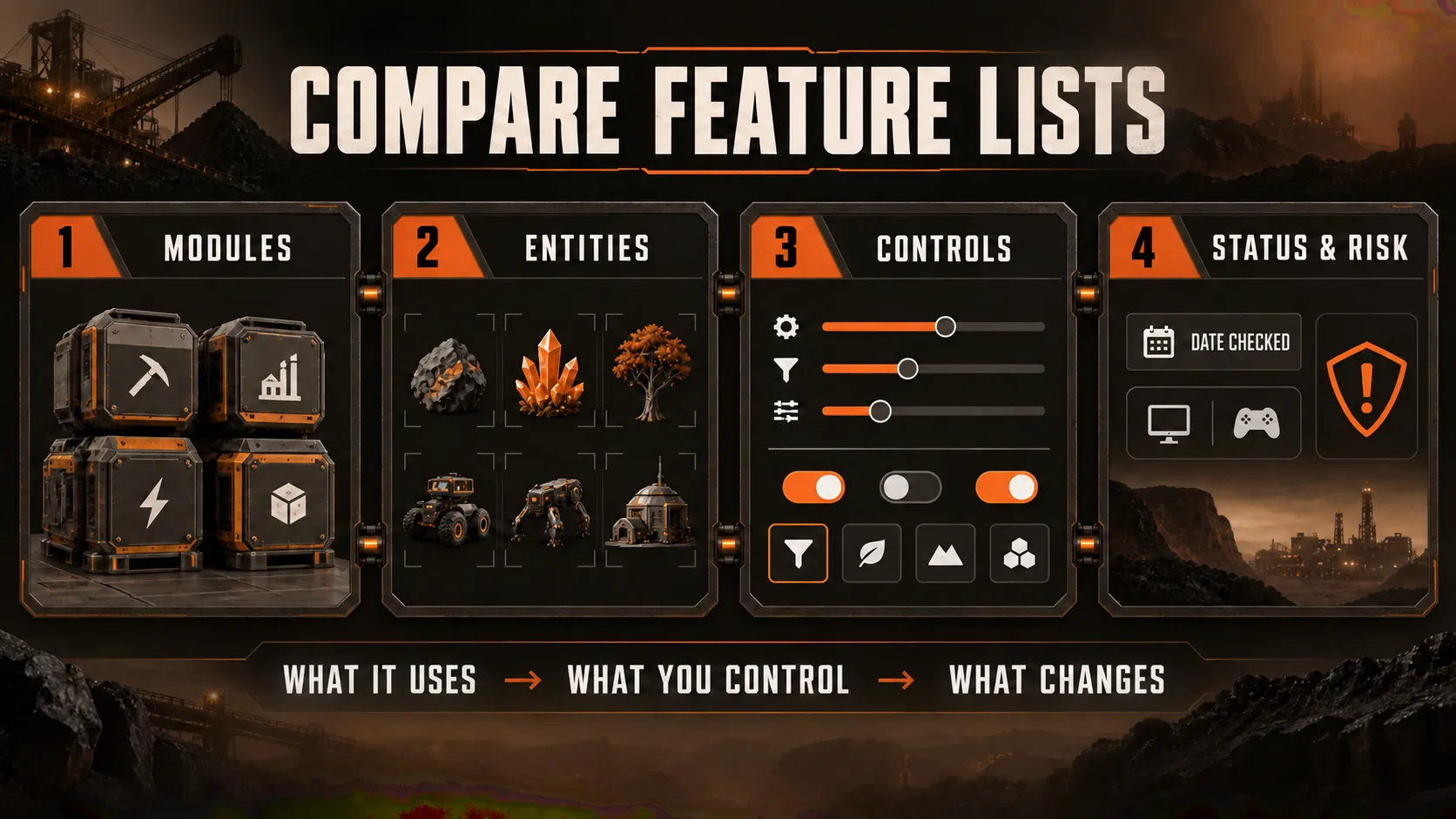
1. Separate the modules
Group every listed feature under Aimbot, Player/ARC ESP, Loot ESP, Radar, weapon modifications, protection or capture output.
This exposes duplicated marketing labels and missing categories.
2. Check the supported entities
“ESP included” is incomplete.
Look for whether it supports enemy Raiders, teammates, knocked players, ARC machines, items, containers, corpses, drops and extraction markers.
The entity list determines what the module can display.
3. Check the controls, not only the headline
An Aimbot with only an on/off switch is different from one with target filters, FOV, smoothing, prediction and aim-point controls.
The same applies to ESP distances, Loot ESP categories, Radar scale and recoil strength.
4. Separate current status from permanent claims
Ask when the build was last checked and what happens after an update.
“Undetected forever” and “ban-proof” are not credible technical statuses.
A dated status plus a clear pause-and-update process is more meaningful.
5. Check the platform and setup separately
Feature availability and setup can differ by platform.
Confirm the exact device, game version and required configuration before assuming that a general compatibility badge applies to your setup.
6. Read the risk language
A clear provider distinguishes compatibility, detection, account bans and hardware bans.
It should also state that an HWID Spoofer or Stream-Safe Mode cannot eliminate enforcement risk.
If you want to inspect the current ARC Raiders Ultimate build before choosing an access period, the free one-day cheat trial includes the same current feature set as the paid build.
Check the current status and platform instructions first, because a trial does not remove anti-cheat or ban risk.
Key Takeaways
- ARC Raiders cheats are a bundle of different modules, not one universal tool.
- Aimbot controls target selection and aim correction; ESP and Wallhack expose entity information and visibility.
- Loot ESP filters items and world objects, while Radar turns selected positions into a spatial overview.
- No Recoil, No Spread and No Sway are weapon modifications, not Aimbot settings.
- An HWID Spoofer is a hardware-identity protection feature, not a guarantee against bans.
- Stream-Safe Mode affects capture output, not anti-cheat visibility.
- “Undetected” describes a current tested status and can change after an update.
- ARC Raiders uses multiple anti-cheat and enforcement layers, including account and hardware restrictions.
FAQ
What are ARC Raiders cheats?
ARC Raiders cheats are third-party tools that add information, aim assistance, weapon-behavior controls or protection features outside the standard game.
Common categories include Aimbot, Player and ARC ESP, Wallhack, Loot ESP, Radar, weapon modifications and an HWID Spoofer.
A specific build may include some or all of them.
Are ARC Raiders cheats and hacks the same thing?
Usually, yes.
Players and providers often use “cheats” and “hacks” as search synonyms.
The exact feature list matters more than the label because the words do not tell you which modules or controls are included.
How do ARC Raiders cheats work?
At a high level, they read or infer supported game state, filter the relevant entities or values, and then display information or apply a configured action.
ESP renders information, Radar maps positions, and Aimbot uses eligible targets to influence aim correction.
Implementations vary and are not publicly documented in full.
What is the difference between ESP and Wallhack?
ESP is the broader information overlay, while Wallhack normally refers to keeping supported entities visible through cover.
ESP can also show boxes, skeletons, health, distance, equipment and direction indicators.
Providers sometimes use the words interchangeably, so check the actual option list.
Is Loot ESP the same as Player ESP?
No.
Player ESP focuses on Raiders, teammates or ARC machines, while Loot ESP focuses on items, containers, corpses, drops and extraction-related markers.
They can share an overlay but use different categories and filters.
Is Radar the same as ESP?
No.
Radar usually presents selected positions in a compact 2D spatial view, while ESP attaches information to entities in the game scene.
Radar is faster for direction and relative position; ESP can provide richer detail about an individual target or object.
What is the difference between Aimbot and No Recoil?
Aimbot selects and tracks eligible targets.
No Recoil changes weapon kick during firing.
They can be used in the same build, but one affects target correction and the other affects weapon behavior.
What does undetected mean?
Undetected should mean that no active detection is known for the tested build at the time of the status check.
It does not mean permanently safe, ban-proof or immune to later detection.
Game updates, anti-cheat changes, reports and telemetry can change risk.
Can an HWID Spoofer prevent every hardware ban?
No.
An HWID Spoofer is designed to mask or alter hardware identifiers, but it cannot guarantee that a PC or account will never be detected or restricted.
Embark does not disclose its exact hardware fingerprinting method, and its enforcement systems can change.
Can you get banned for using ARC Raiders cheats?
Yes.
Embark’s policy allows temporary, permanent and, for serious violations, hardware-level enforcement.
The company also uses multiple anti-cheat and telemetry layers.
No cheat provider can honestly guarantee zero ban risk.
Does a game update automatically mean a cheat is detected?
No.
An update can create a compatibility problem without causing a detection, but it can also change security conditions.
The correct response is to check the current build status after the update rather than assuming that an older test still applies.