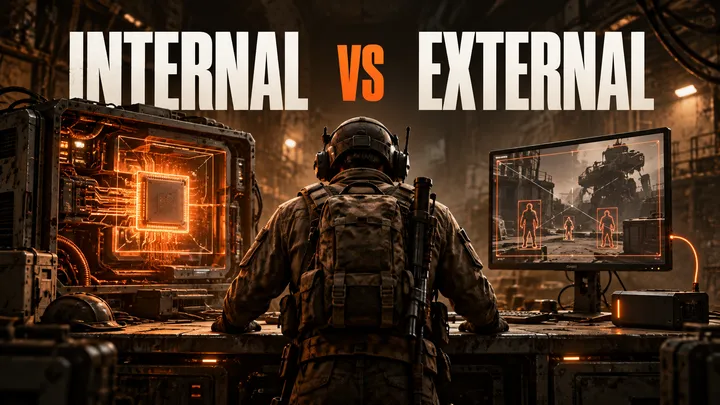
The terms internal and external describe where cheat software runs and how it communicates with ARC Raiders.
They do not tell you, by themselves, which build is safer, faster or better.
This ARC Raiders internal vs external cheats comparison explains the architectural difference, what it can change for features and setup, and why update quality matters more than a category label.
Table of Contents
- ARC Raiders Internal vs External Cheats at a Glance
- What Is an ARC Raiders Internal Cheat?
- What Is an ARC Raiders External Cheat?
- [Internal vs External Architecture: What Changes in Practice?]> (#internal-vs-external-architecture-what-changes-in-practice)
- Is an External ARC Raiders Cheat Safer Than an Internal One?
- External Software Is Not the Same as DMA
- How to Compare ARC Raiders Cheat Architecture Without Guessing
- Which Is Better: ARC Raiders Internal or External?
- Key Takeaways
- FAQ
ARC Raiders Internal vs External Cheats at a Glance
An internal cheat runs code inside the ARC Raiders game process, while an external cheat remains in a separate process and accesses the game from outside it.
That difference can affect data access, rendering, feature design, setup and what must be updated after a patch.
| Comparison point | Internal cheat | External cheat |
|---|---|---|
| Where it runs | Inside the game process | In a separate process |
| Game-data access | Direct access from within the process | Reads or exchanges data across a process boundary |
| Typical display method | May hook the game’s rendering path or draw an in-game menu | Often uses a separate overlay, window or companion display |
| Feature potential | Often suited to features requiring close game integration | Often suited to ESP, radar and aim assistance, but design matters more than the label |
| Setup | Usually depends on a loader and an internal module | Usually starts as a separate application, sometimes with an overlay |
| Patch sensitivity | Can break when internal functions, structures or rendering paths change | Can break when data layouts, offsets, access methods or overlay behavior change |
| Detection risk | Detectable | Detectable |
Verdict: Internal offers closer integration. External keeps the main application separate.
Neither architecture is inherently undetectable, and neither guarantees a particular feature list.
For a broader explanation of aimbot, ESP, radar and other terminology, use our cheats explained guide.
This page stays focused on architecture rather than repeating the full feature glossary.
What Is an ARC Raiders Internal Cheat?
An ARC Raiders internal cheat places executable code within the game’s process.
In practical terms, the cheat operates in the same address space as ARC Raiders instead of requesting data from a separate program.
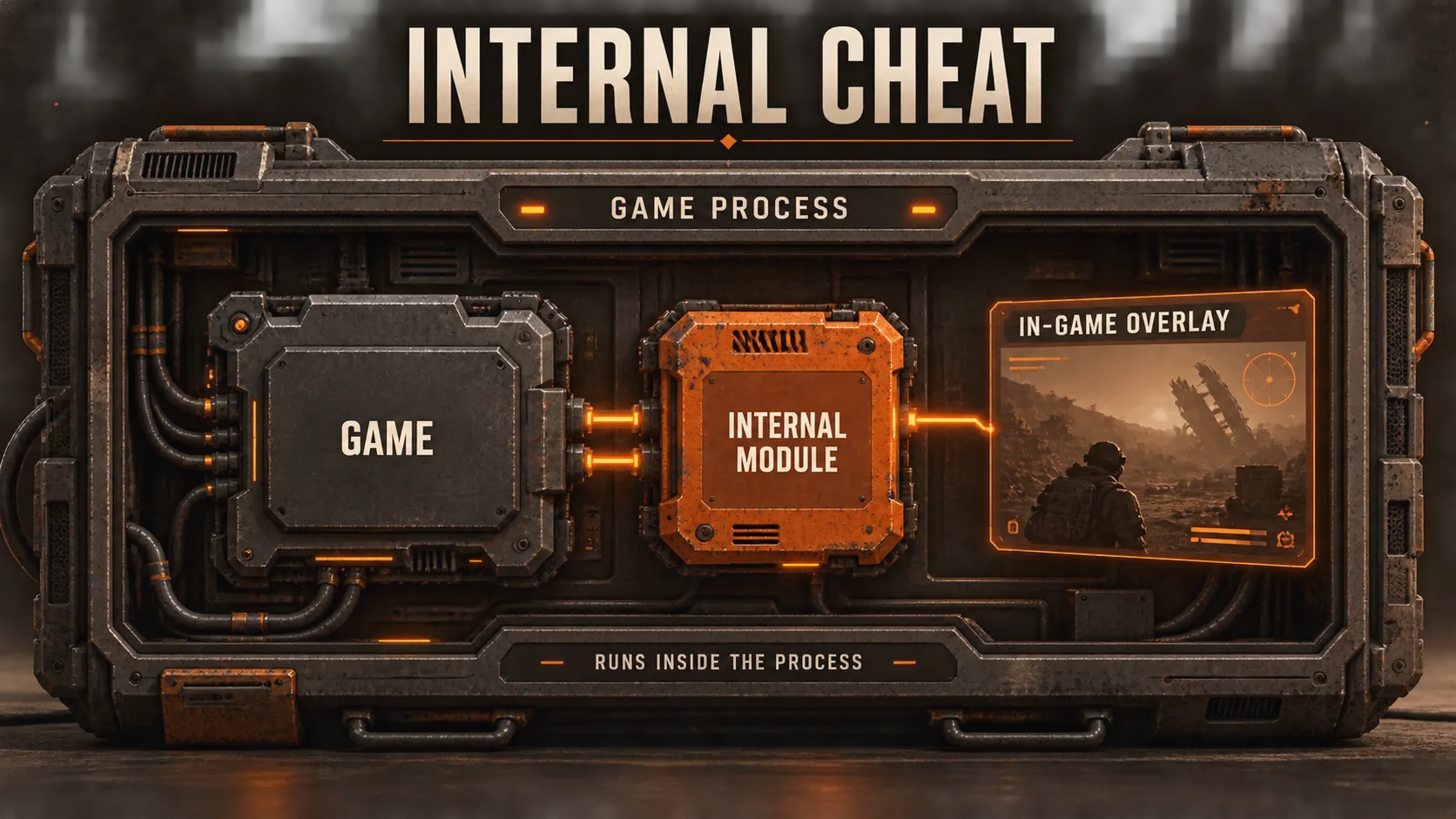
MITRE defines process injection as executing code in the address space of another live process.
Internal cheat designs are often discussed in those terms, although the exact loading method can differ between products.
Because the code is already inside the process, an internal build may interact closely with game objects, internal functions and the rendering pipeline.
That can make certain interfaces or tightly integrated features easier to implement.
It does not mean every internal product has every feature, nor does it prove that those features work well.
Common characteristics of internal builds
- A loader starts or places a module in the game process.
- The menu may appear as part of the game window.
- Features can use data and functions available inside the process.
- Updates may be needed when a patch changes internal structures or functions.
- A crash in the internal module can also interrupt the game process.
The practical advantage is integration, not automatic superiority.
A carefully built external can outperform a poorly maintained internal in stability, usability and update speed.
What Is an ARC Raiders External Cheat?
An ARC Raiders external cheat runs as a separate application.
It retrieves or processes game information from outside the ARC Raiders process, then presents or acts on that information through its own components.
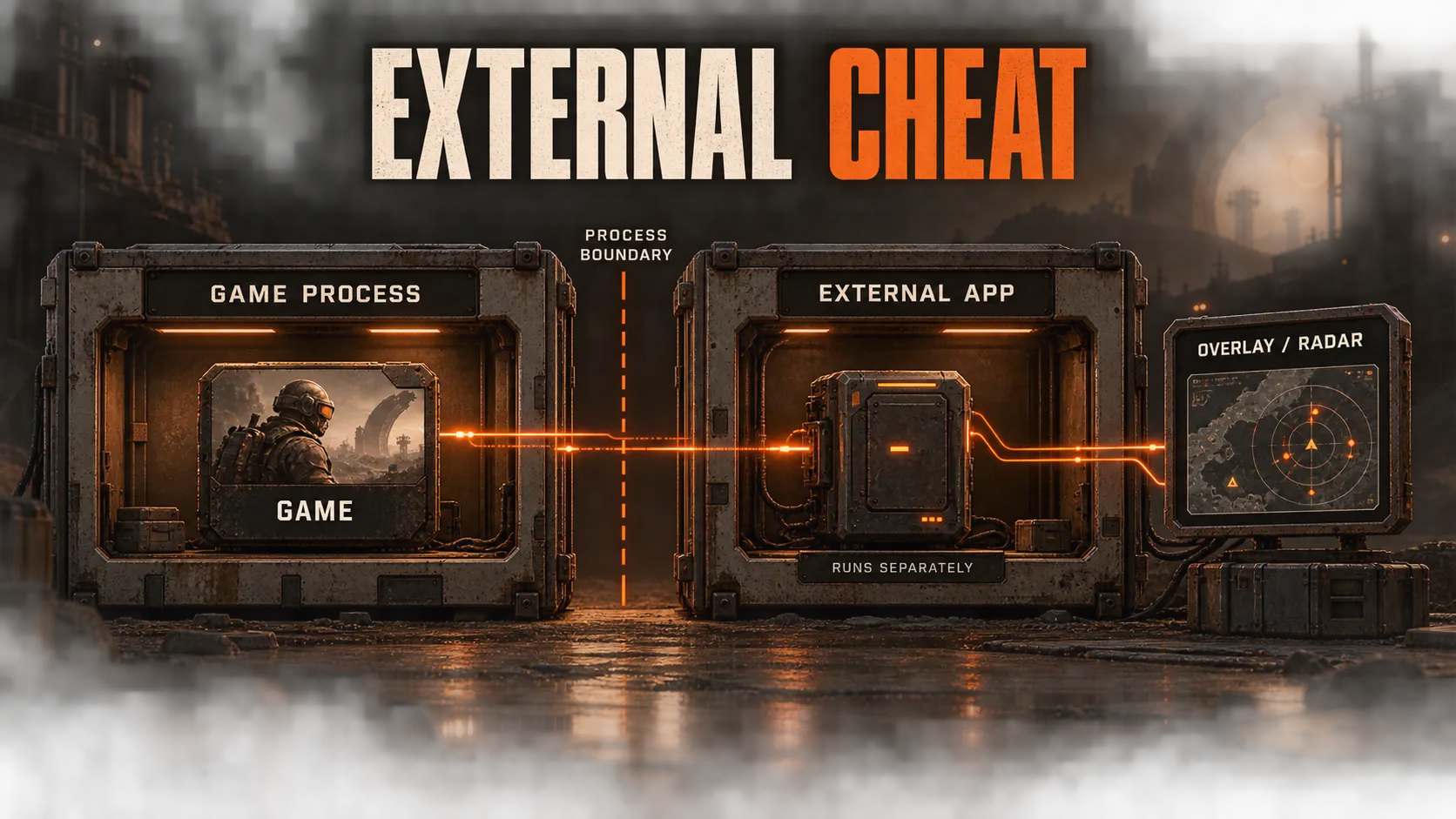
Windows supports controlled cross-process memory access through documented interfaces.
For example, Microsoft’s ReadProcessMemory documentation explains that an authorized process can copy data from another process’s address space into its own buffer.
That is a general operating-system capability, not a guarantee that any particular external cheat uses that exact method.
External builds commonly use a separate overlay or radar window.
However, “external” does not mean “ESP only.”
An external product may offer aim assistance, player information, loot filters or radar if its data access and output design support them.
Common characteristics of external builds
- The main cheat application remains outside the game process.
- Visual information may appear in an overlay, separate window or second display.
- The product still needs a reliable way to obtain current game data.
- Game updates can invalidate the data layout or access method it relies on.
- Overlay timing and data refresh can affect how responsive the result feels.
The practical advantage is separation, not immunity.
Embark explicitly warns that external software interacting with ARC Raiders can trigger anti-cheat violations.
Internal vs External Architecture: What Changes in Practice?
Architecture shapes how a feature is built. It does not define the feature by itself.
Two products in the same category can have very different menus, performance, supported hardware and update histories.
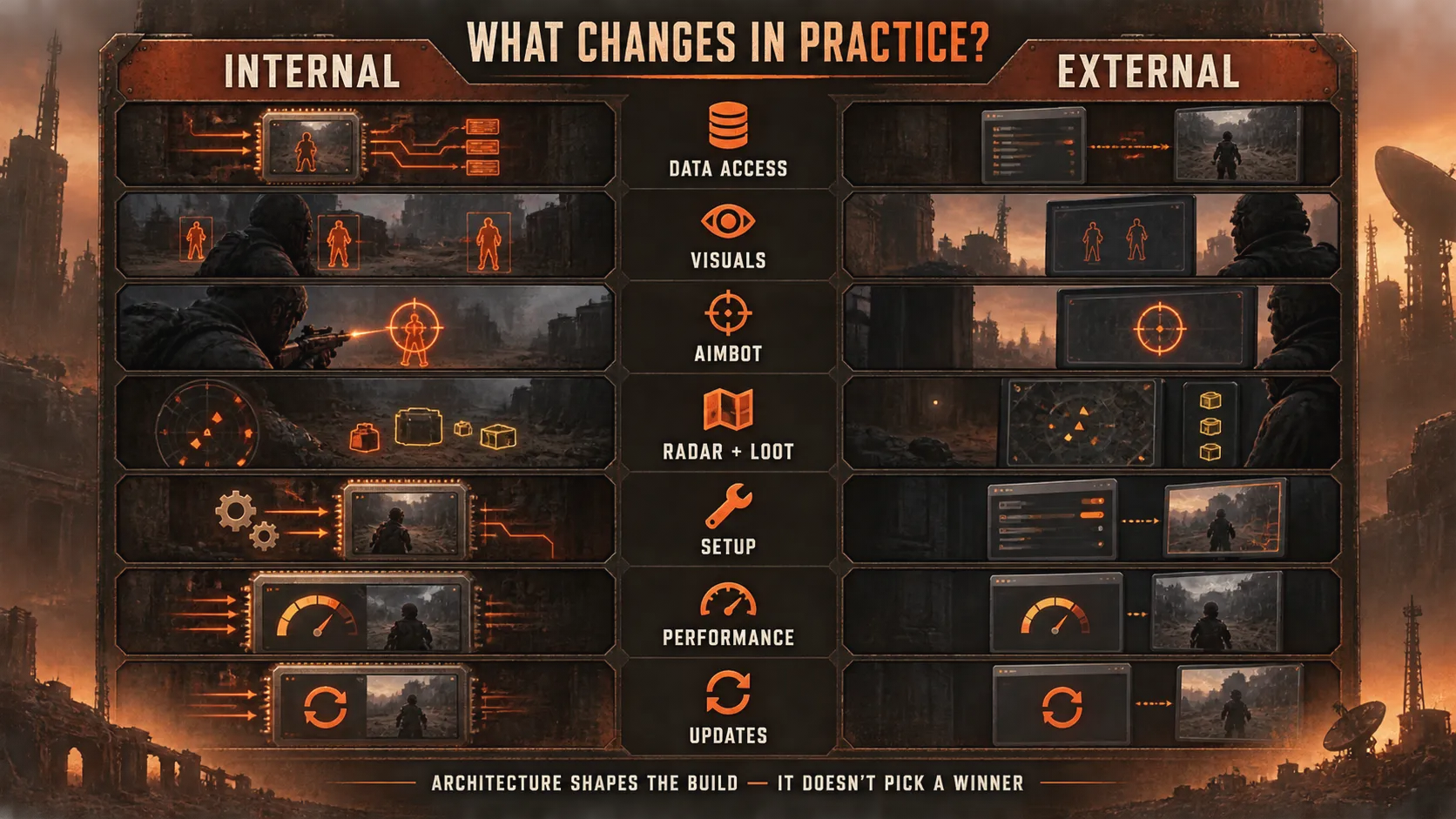
1. Data access
Internal code already operates in the game’s address space.
External code must cross a process boundary, receive data through another component or use a separate data source.
This distinction affects engineering complexity and latency, but it does not produce a universal winner.
The result depends on what data is needed, how often it is refreshed and how efficiently the product processes it.
Verdict: Internal has more direct access. External introduces another communication layer, but a well-designed external can still refresh common visual and targeting data quickly.
2. Visuals and overlays
Internal visuals may be drawn through the game’s rendering path.
External visuals are commonly drawn in a transparent overlay or displayed in a separate radar window.
For players comparing ESP and Wallhack controls, the visible result can look similar: boxes, skeletons, health, distance and other filters.
The meaningful questions are whether the overlay aligns correctly, stays readable at the chosen resolution and maintains a consistent refresh rate.
Verdict: Internal can integrate the menu and visuals more closely with the game. External can keep the interface separate and may support companion-display formats more naturally.
3. Aimbot behavior
An internal architecture can access game state from inside the process, while an external architecture must calculate and apply its correction from outside or through a companion component.
Both categories can advertise aim assistance, so the label alone says little about smoothness or target selection.
Compare the controls that affect real behavior: FOV, smoothing, prediction, bone selection, maximum distance and target switching.
Our ARC Raiders Aimbot page explains what those settings change without treating architecture as a substitute for configuration quality.
Verdict: Internal can support tighter integration, but the quality of targeting logic and tuning matters more to the player than the category name.
4. Radar and loot information
Radar and ESP are natural fits for external presentation because the information can be rendered away from the main game view.
A separate window may also be easier to place on another monitor.
That does not make radar exclusively external.
Internal builds can render radar too.
Likewise, both architectures can support Loot ESP filters if they can reliably identify items, containers and extraction data.
Verdict: External often suits separate-window radar well. Feature coverage still depends on the build, not the word “external.”
5. Setup and compatibility
Internal and external are architectural labels, not installation standards.
One internal product may have a guided loader; another may require more troubleshooting.
One external may be a single companion app; another may depend on additional components or a specific display mode.
Before choosing, check:
- Supported Windows versions and hardware
- Intel and AMD compatibility
- Required display mode for overlays
- Whether a second monitor or device is optional or required
- Loader, driver or companion-component requirements
- Support instructions after an ARC Raiders update
- Whether every advertised feature is included in the same build
The complete feature list is more useful than assuming what a product includes from its architecture.
Verdict: External often looks simpler because it launches separately, but the real setup burden depends on the complete product design.
6. Performance and stability
Internal code shares the game’s process and can interact with its render loop.
External code consumes resources in a separate process and may draw an additional overlay.
Either approach can cause frame loss, stutter or crashes if implemented poorly.
Architecture alone cannot support a credible “zero FPS loss” claim.
Performance must be tested on the player’s hardware, resolution, graphics settings and chosen feature configuration.
Verdict: Neither category automatically performs better. Build quality and feature load are the stronger predictors.
7. Updates after ARC Raiders patches
Both architectures are patch-sensitive.
Internal builds may depend on game functions, objects or hooks that change.
External builds may depend on data structures, addresses, access components or overlay behavior that also change.
Embark’s anti-cheat stack has expanded throughout 2026.
Its May fair-play overview described kernel-level Easy Anti-Cheat protection, machine-learning models trained on player telemetry and additional undisclosed layers.
Denuvo Anti-Cheat was subsequently rolled out to all players.
Embark has continued refining hardware and software detection and ML-driven input analysis, alongside its work with Anybrain and Denuvo.
That means a provider must respond to more than a single signature or one anti-cheat component.
The better comparison is operational:
- Does the provider suspend access when compatibility is uncertain?
- Does it publish clear status updates?
- Does it retest features after major game patches?
- Does support distinguish a game update from a local setup problem?
- Does it avoid promising permanent detection immunity?
Our ARC Raiders anti-cheat guide covers the protection stack in more depth.
Verdict: Update discipline matters more than whether the build is internal or external.
Is an External ARC Raiders Cheat Safer Than an Internal One?
No architecture label can establish safety.
External software still interacts with the game or its data, and internal software still varies widely in how it is built, loaded and maintained.
Detection can involve several signal types:
- Software or driver indicators
- Unauthorized interaction with the game process
- Manipulation of rendering or input
- Known code or component signatures
- Suspicious gameplay and input telemetry
- Reports followed by account review
Embark says its systems analyze both kernel-level activity and player telemetry.
It also states that cheats, hacks, gameplay-affecting third-party tools and attempts to bypass anti-cheat protections can result in enforcement.
Temporary, permanent and hardware bans are possible, as detailed in our ARC Raiders ban guide.
The accurate comparison is not “external equals safe” versus “internal equals risky.” Both are detectable.
Architecture changes the detection surface, but it does not remove that surface.
External Software Is Not the Same as DMA
DMA is related to the external-cheat discussion, but it is a separate hardware-assisted category.
A normal external application runs on the gaming PC and obtains data through software components on that system.
A DMA setup typically adds dedicated hardware and often uses a second computer to process or display information.
| Category | Runs on gaming PC | Dedicated hardware | Second PC commonly used | Same as a normal external? |
|---|---|---|---|---|
| Internal | Yes, inside game process | No | No | No |
| Software external | Yes, separate process or components | Not inherently | Not inherently | Yes |
| DMA setup | Uses hardware connected to the gaming system | Yes | Often | No |
DMA does not deserve an automatic “undetectable” label either.
Hardware, firmware, software, data access and player behavior can all create risk.
Treat any seller claiming guaranteed safety as a marketing claim, not a technical fact.
How to Compare ARC Raiders Cheat Architecture Without Guessing
Use the following framework instead of choosing from the internal or external label alone.
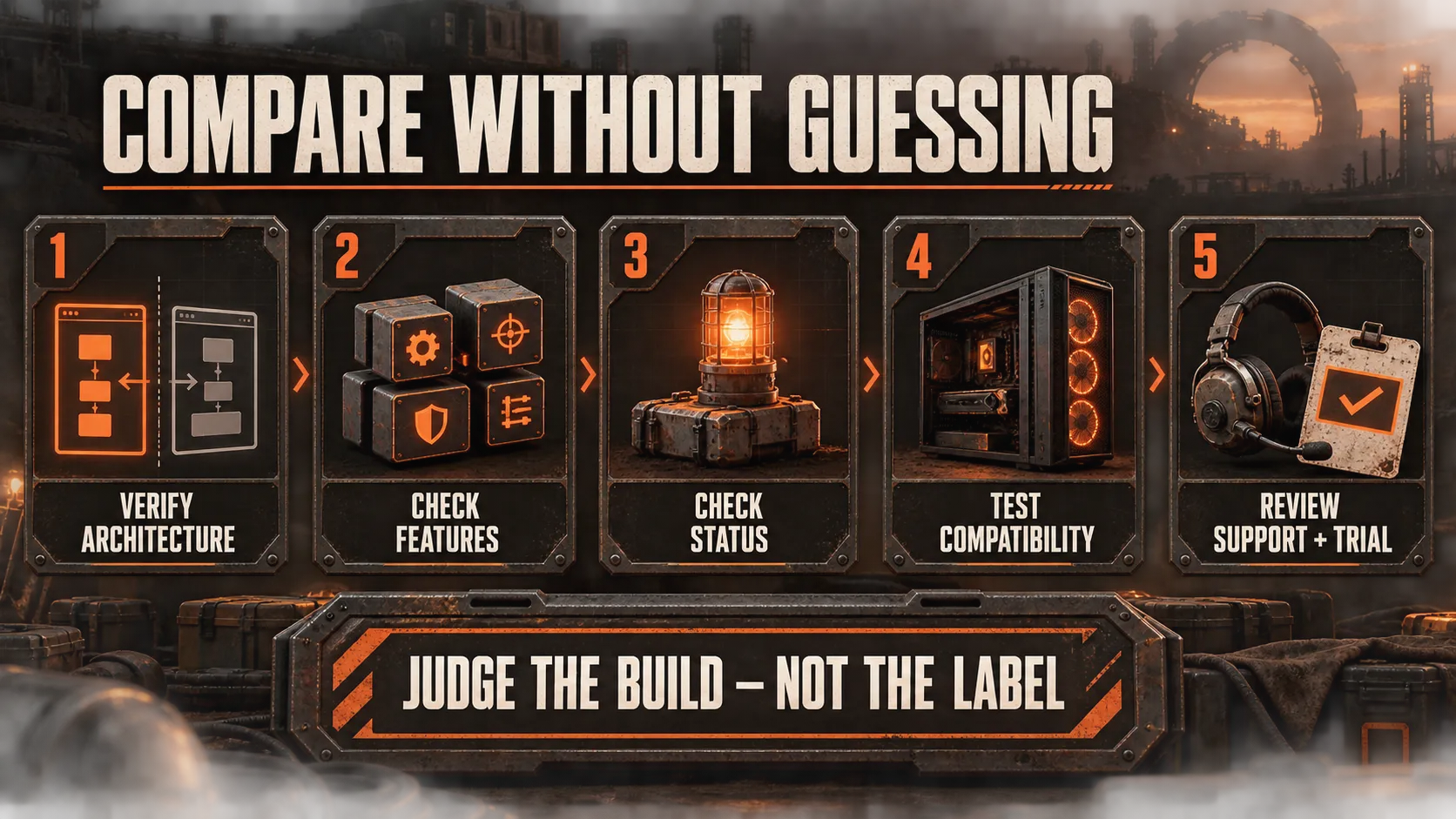
Verify the architecture claim
Ask what “internal” or “external” means for that specific build.
Some storefronts use the terms loosely, and hybrid designs can combine an external interface with lower-level companion components.
Compare the exact feature list
Check the current build rather than an old showcase.
If radar, aim modes, loot categories or visual filters matter, verify each one individually.
Our ARC Raiders Radar guide shows the level of detail a feature description should provide.
Check update and status handling
A provider should clearly mark a build as available, updating or offline.
Fast marketing language is less useful than a status history and explicit instructions not to launch during uncertain compatibility.
Check support and trial access
Setup quality becomes obvious only on the hardware that will run the software.
If you want to assess the interface, compatibility and feature controls before choosing a longer plan, use the free one-day trial and follow the supplied setup guidance.
Treat guarantees carefully
“Undetected” is a current status claim, not a permanent property.
Embark can change detection methods, and it does not disclose every layer.
Its ban policy also makes clear that hardware restrictions can be final and non-appealable.
Our HWID ban explanation covers that consequence separately.
Which Is Better: ARC Raiders Internal or External?
Choose based on the current build, not the category name.
- Consider an internal build if close game integration and a unified in-game interface matter most, and the provider has a strong update process.
- Consider an external build if a separate overlay or radar window suits your setup, and its exact features and compatibility have been verified.
- Do not assume either is safer. Both interact with a protected online game and both can be detected.
- Do not treat DMA as a synonym for external. It adds hardware, cost and setup complexity.
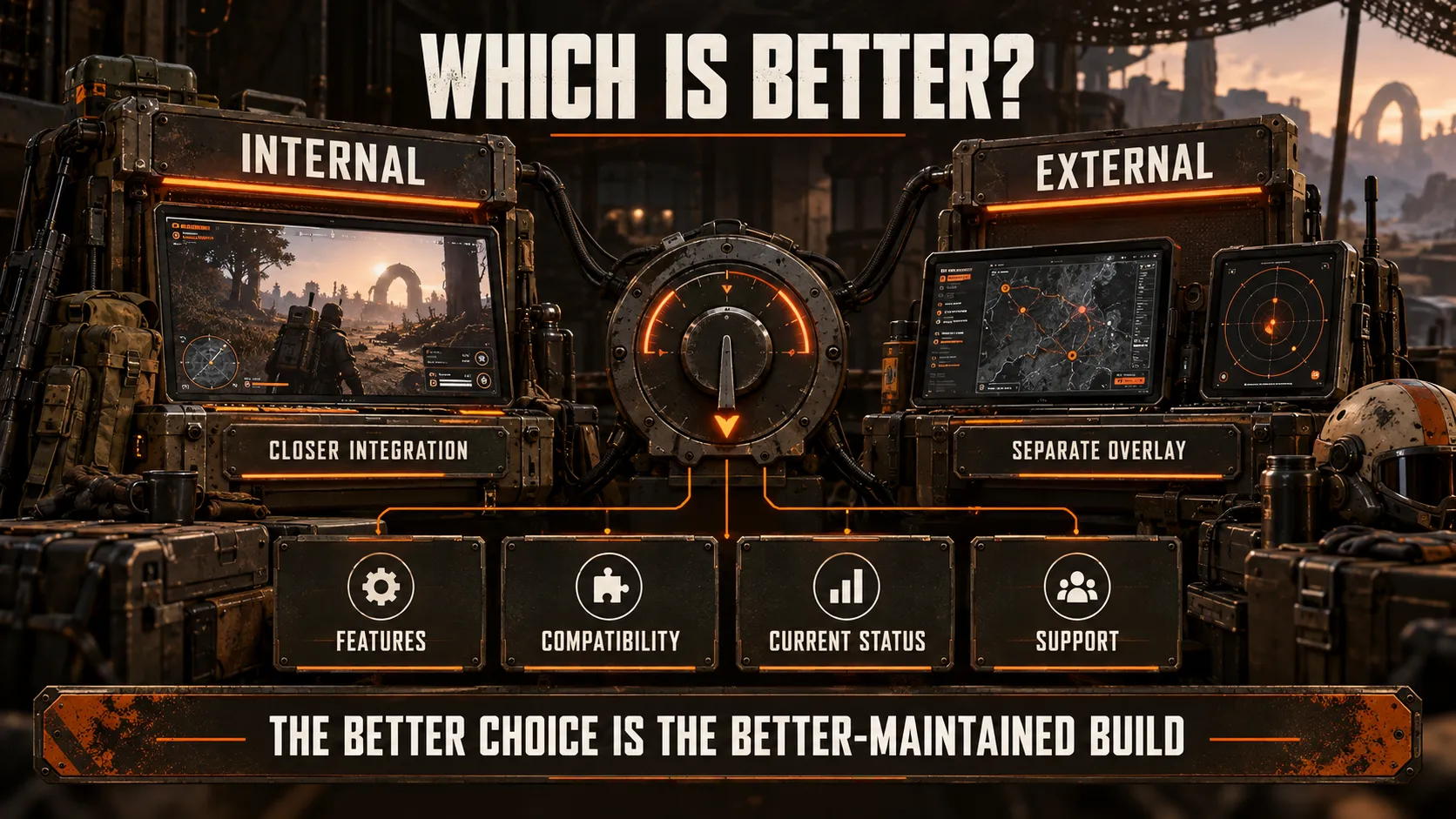
For ARC Raiders, the useful buying question is:
Does this current build provide the features, compatibility, support and update handling you need?
Internal versus external is one part of that answer.
Key Takeaways
- Internal cheats run code inside the ARC Raiders process; external cheats remain separate.
- Internal architecture offers closer integration, while external architecture often suits overlays and separate radar displays.
- Aimbot, ESP, Loot ESP and radar can exist in either category.
- Both architectures can break after patches and both require active maintenance.
- External does not mean undetectable, and internal does not mean automatically feature-rich.
- DMA is a separate hardware-assisted approach, not another name for a standard external cheat.
- Compare the live feature list, compatibility, status process and support before choosing.
Frequently Asked Questions
What is the main difference between internal and external ARC Raiders cheats?
An internal cheat runs code inside the ARC Raiders process.
An external cheat runs separately and obtains or processes game data from outside that process.
This difference shapes how features are implemented, displayed, and updated.
Are external ARC Raiders cheats safer than internal cheats?
Not inherently.
External software still creates detectable interactions, and Embark warns that software interacting with the game can trigger anti-cheat violations.
Product quality, access methods, updates, and player telemetry all matter.
Do internal ARC Raiders cheats have more features?
They can support close integration with game functions, but the architecture does not guarantee a larger feature list.
External builds can also offer Aimbot, ESP, Loot ESP, and Radar.
Compare the current product’s documented controls instead of assuming.
Can an ARC Raiders external cheat include Aimbot?
Yes.
An external build can calculate target information and apply aim assistance through its chosen architecture.
Responsiveness and smoothness depend on the specific implementation and configuration.
Is ESP usually internal or external?
ESP can be built either way.
Internal ESP may draw through the game’s rendering path, while external ESP often uses an overlay.
The visible result and available filters depend on the product.
Is Radar an external cheat?
Radar is a feature, not an architecture.
It is often convenient to display Radar through an external window or second screen, but an internal build can render Radar as well.
Is DMA the same as an external ARC Raiders cheat?
No.
A standard external is software running separately on the gaming PC.
DMA adds dedicated hardware and commonly a second computer, so its cost, setup, and architecture are different.
Which type is easier to update after an ARC Raiders patch?
Neither category is always easier.
Internal functions and hooks can change, while external data layouts and access components can also break.
Provider testing and status management matter more than the label.
Can either type cause an ARC Raiders ban?
Yes.
Embark’s policy prohibits cheats, hacks, unauthorized gameplay-affecting tools, and anti-cheat bypass attempts.
Enforcement can include temporary bans, permanent bans, and, for serious violations, hardware restrictions.
Does external mean the cheat never touches the game process?
No.
It means the main application runs outside the game process.
It may still read data, communicate through another component, or otherwise interact with the protected game environment.